

Tech Defies the Dip: ASX Software Stocks Rise Despite Global Uncertainty


Key Highlights
- ASX 200 slips 0.17% while tech sector gains 0.45%
- ASX All Technology Index edges higher, showing resilience
- Global uncertainty rises amid inflation concerns and tech leadership shifts
- Consumer confidence near historic lows, yet software stocks hold ground
- Signals rotation into scalable, asset-light business models
ASX slips as global uncertainty lingers, but tech finds its footing
The ASX 200 is trading slightly lower on Tuesday, down 0.17% to 8,937.8 by early afternoon, as markets absorb a mix of inflation signals, global leadership changes, and domestic legal tensions.
Overnight, Wall Street finished in the red, with the S&P 500 down 0.2% and the Nasdaq slipping 0.3%, while European markets fell more sharply. Brent crude is hovering near $US94.89 a barrel, easing slightly but still reflecting ongoing geopolitical unease.
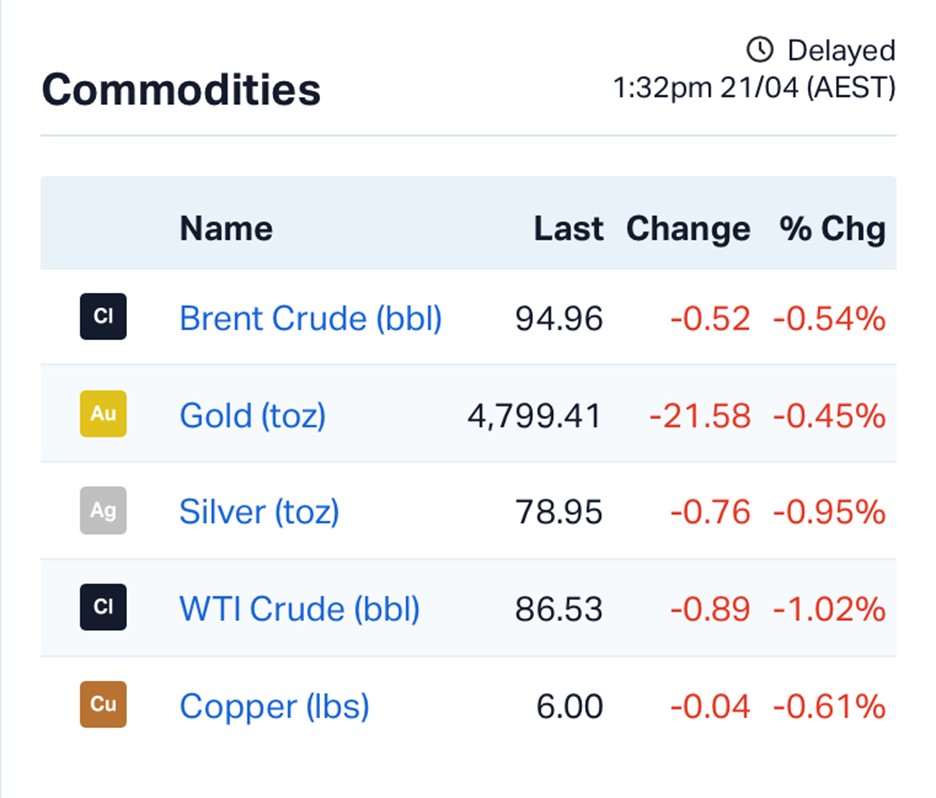
Commodities Price Index | Source: MarketIndex
Yet amid this uncertainty, one corner of the market is quietly pushing higher.
The information technology sector is up 0.45%, with the ASX All Technology Index also edging into positive territory, a modest gain on paper but notable given the broader market weakness.
A quiet divergence
Financials are down 1.01%, energy has fallen 1.20%, and healthcare is also weaker. These are traditionally large, index-heavy sectors, and their decline is dragging the broader market lower.
Tech, by contrast, is moving against the tide and so is real estate.
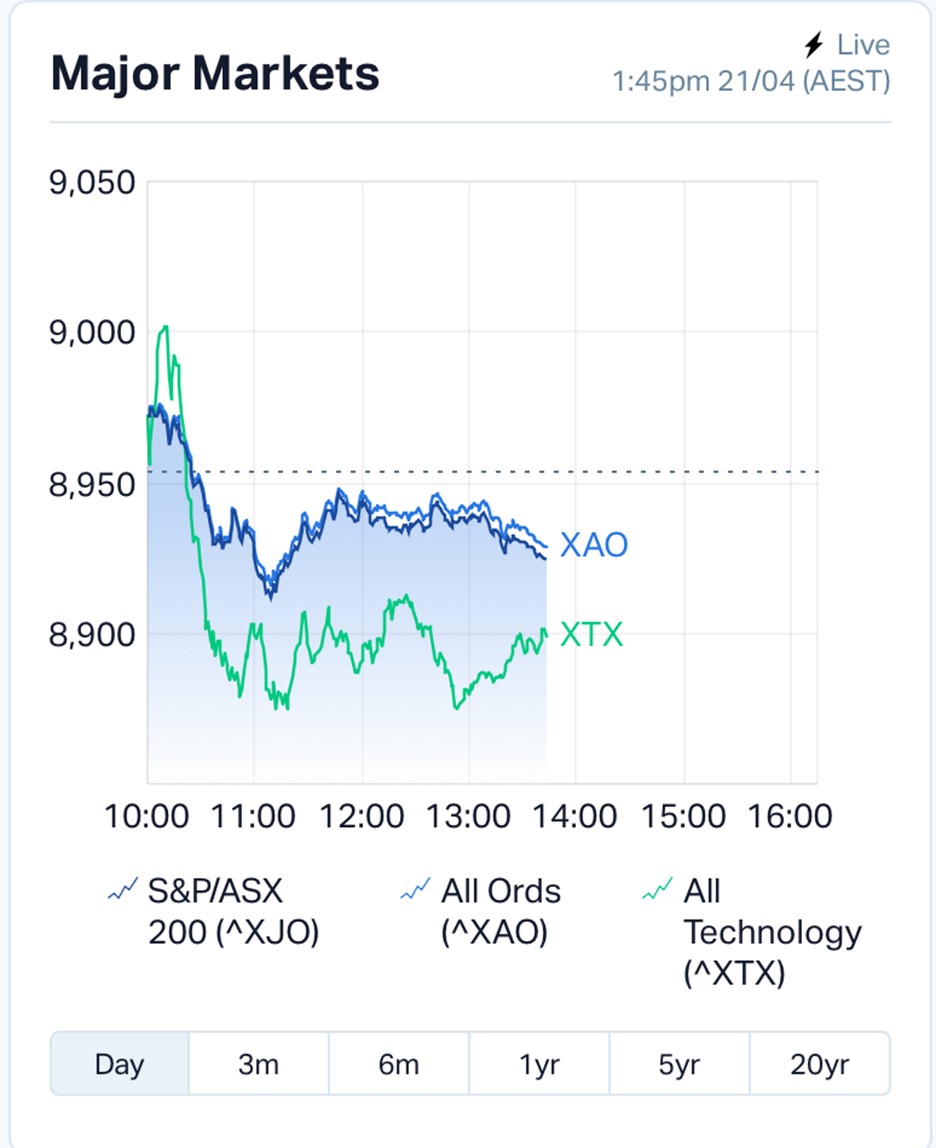
This divergence points to a subtle shift in market positioning.
Rather than chasing cyclical sectors tied to commodities or interest rates, some capital appears to be rotating toward businesses that are less exposed to immediate economic shocks.
Why software is holding up
Part of the answer lies in the nature of software businesses.
Unlike mining or energy companies, which depend heavily on global demand cycles and commodity prices, software firms often operate on recurring revenue models.
This provides a level of predictability that becomes more attractive in uncertain conditions.
There is also a structural story at play.
Global demand for digital infrastructure continues to expand, driven by artificial intelligence, cloud computing, and automation.
Even as broader markets react to short-term macro pressures, these longer-term trends remain intact.
Recent commentary from market analysts suggests that Australian tech may have already undergone a valuation reset over the past two years, leaving it better positioned relative to earlier peaks.
Global signals shaping sentiment
The resilience in local tech stocks comes against a backdrop of shifting global narratives.
In the United States, attention is turning to leadership changes at Apple, where John Ternus is set to replace Tim Cook later this year.
Wedbush analysts noted that the transition places significant pressure on the company’s upcoming artificial intelligence strategy, highlighting how central AI has become to the sector’s next growth phase.
At the same time, inflation remains a key concern closer to home.
New Zealand’s latest CPI reading came in at 3.1% annually, still above the central bank’s target range.
Rising electricity costs were a major contributor, underscoring how energy prices continue to ripple through the broader economy.
Sophia Angala, economist at ANZ, said weekly inflation expectations have climbed to 7.1%, adding that the bank expects the Reserve Bank of Australia to raise interest rates by 25 basis points in May.
Confidence remains fragile
Despite the relative strength in tech, the broader economic backdrop is far from stable.
Consumer confidence is sitting at 64.3 points, its fourth-lowest level since 1973, according to the ANZ-Roy Morgan survey.
Higher fuel prices, persistent inflation, and a steady unemployment rate of 4.3% are weighing on sentiment.
In an unusual shift, the Reserve Bank has also reported a rise in physical cash usage, reversing a long-standing trend toward digital payments.
This suggests households may be becoming more cautious, holding onto liquidity as uncertainty builds.
Stay ahead of the market
The most important stories, delivered to your inbox. No noise, just what matters.
By subscribing, you agree to our Privacy Policy.
Stock-level movement tells a mixed story
Across the market, gains remain selective.
Viridis Mining and Minerals is leading the winners, up 28.02%, followed by Energy Resources of Australia and Artrya, which has gained more than 11%.
On the downside, Elixir Energy and HUB24 are among the biggest fallers, each down close to 7%.
The contrast highlights how fragmented the current market environment has become.
Rather than broad-based rallies or sell-offs, movements are increasingly driven by company-specific factors and sector dynamics.
Historical perspective
This is not the first time technology has diverged from the broader market during periods of uncertainty.
During earlier tightening cycles, particularly in the early 2000s and post-Global Financial Crisis era, software companies with strong balance sheets and recurring revenue streams often proved more resilient than capital-intensive industries.
However, the current cycle is different in one key respect.
The rise of artificial intelligence and data-driven services has accelerated the strategic importance of software across nearly every industry.
This has turned technology from a growth niche into a foundational layer of the global economy.
The Bigger Picture
The relative strength in ASX technology stocks reflects a broader shift in how markets are navigating uncertainty. In an environment shaped by inflation concerns, geopolitical tension, and cautious consumer behaviour, companies built on scalable, recurring revenue models are finding renewed support.
Rather than chasing cyclical rebounds, the market appears to be leaning toward durability and long-term relevance, a trend that suggests confidence is no longer anchored in short-term recovery, but in structural growth that can persist even as the broader economic landscape remains unsettled.
What is your take on this story?
Disclaimer - Skrill Network is designed solely for educational and informational use. The content on this website should not be considered as investment advice or a directive. Before making any investment choices, it is crucial to carry out your own research, taking into account your individual investment objectives and personal situation. If you're considering investment decisions influenced by the information on this website, you should either seek independent financial counsel from a qualified expert or independently verify and research the information.