


The Counter-Drone Pivot: Why Big Defense is Tapping This ASX Tech Firm for “Smart” Weapons

Team Skrill Network
Team Skrill Network comprises seasoned professionals from diverse fields including Finance, Mining, Technology, Investing, and Digital Strategy. They bring a deep knowledge and understanding of financial markets and behavioural patterns to every story, ensuring credibility and precision in every piece. Whether analysing emerging market trends or spotlighting small- and mid-cap growth companies across ASX, TSX, or NASDAQ, the team’s editorial approach blends data-driven insights with compelling storytelling. Their expertise enables them to process complex developments into content that resonates with both institutional investors and retail audiences. Backed by experience in content curation, SEO strategy, and investor-focused messaging, the team of writers at Skrill Network are committed to delivering stories that matter—authentic, relevant, and strategically aligned with the evolving landscape of global investing.
Read more
Key Highlights
- Hydrix lands $1M to $1.2M counter-drone contract with NIOA Group
- Project focused on “kinetic effector” and inert proximity fuze systems for small drones
- Australia’s counter-UAS spending pipeline now stretches up to $7 billion
- NIOA network spans 75 US State Department-approved countries
- Hydrix expands deeper into sovereign defence and embedded systems engineering
The battlefield has changed quickly over the past three years.
Cheap drones that once hovered over sporting events or carried cameras for hobbyists are now reshaping modern warfare from Ukraine to the Middle East. Militaries are responding just as quickly, pouring billions into technologies designed to detect, disable or destroy them before they strike.
Hydrix Limited has secured a binding contract with global munitions manufacturer NIOA Group to help develop counter-drone payload systems for small uncrewed aerial systems, marking a significant expansion of the company’s growing defence technology footprint.
Market Snapshot
The initial phase of the contract is valued between $1 million and $1.2 million, with development work ramping up immediately ahead of a live demonstration milestone scheduled for December 2026. Design optimisation is expected to continue into the March quarter of 2027.
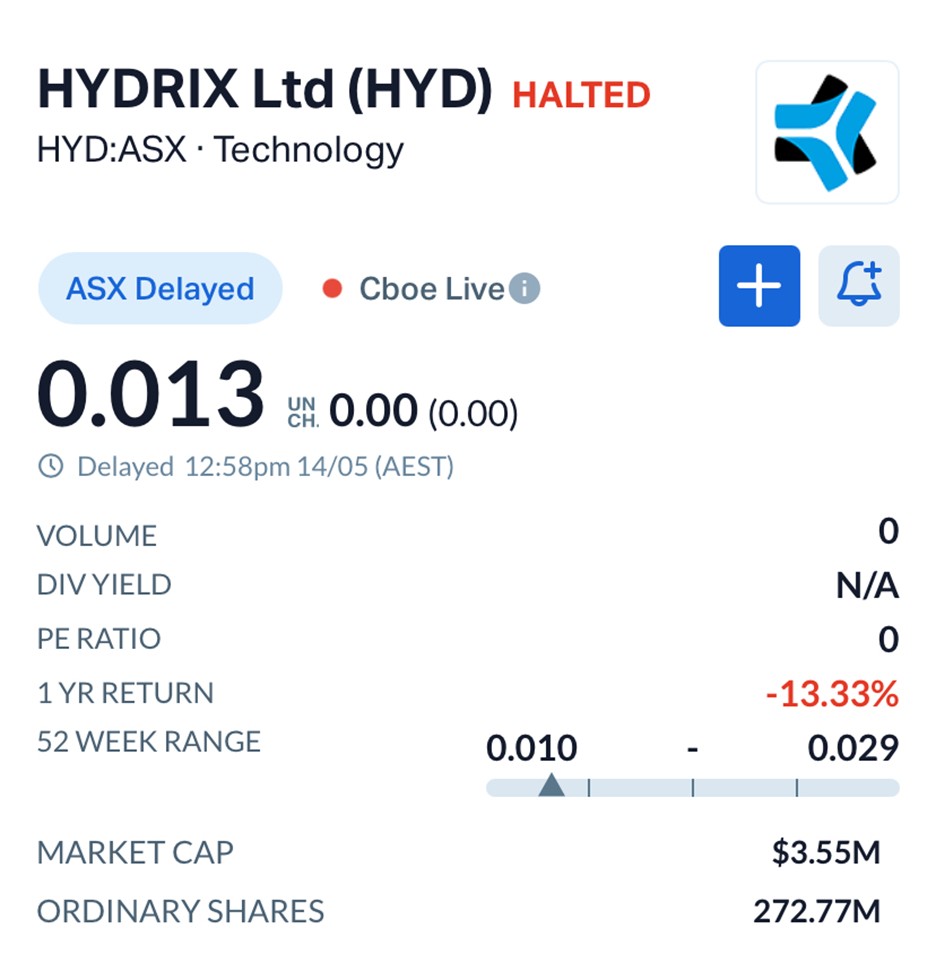
Hydrix shares remained halted on Thursday afternoon at 1.3 cents, giving the company a market capitalisation of roughly $3.55 million.
Source: MarketIndex
Under the agreement, Hydrix will support the integration of NIOA’s telemetry-capable inert proximity fuze and kinetic effector payload package for small drones.
Behind the technical language sits a much larger shift underway across global defence industries.
Modern conflicts have exposed how relatively inexpensive drones can overwhelm traditional military systems, forcing governments to rethink procurement priorities. Counter-UAS technology has become one of the fastest-growing segments in defence spending globally.
Hydrix cited Markets and Markets data showing the global counter-drone market is expected to grow from US$6.6 billion in 2025 to US$20.3 billion by 2030, representing annual growth of roughly 25 per cent.
The Federal Government’s 2026 National Defence Strategy and broader $425 billion Integrated Investment Program include up to $7 billion specifically allocated toward counter-drone capability.
That backdrop is helping smaller engineering firms move closer to the centre of defence supply chains.
Hydrix was selected through a competitive tender process, with the company pointing to its expertise in mission-critical embedded electronics, software engineering and systems integration.
The contract also reflects an unusual evolution for the Melbourne-based group, which built much of its earlier reputation around medical technology and advanced product engineering.
Increasingly, those same engineering capabilities are being redirected toward defence applications.
Hydrix chief executive Gavin Coote said the NIOA agreement strengthened the company’s role within Australia’s sovereign defence technology sector.
“NIOA’s selection of Hydrix further expands our strategic relevance in Australia’s sovereign Defence technologies capability,” Mr Coote said.
“The NIOA project builds on our experience in the design, development and integration of critical sub-systems in counter-UAS applications.”
Stay ahead of the market
The most important stories, delivered to your inbox. No noise, just what matters.
By subscribing, you agree to our Privacy Policy.
NIOA itself carries substantial weight in the defence industry.
Founded in 1973, the privately owned company operates across Australia, New Zealand, the United States and the United Kingdom, with a distribution network spanning 75 countries approved by the US State Department.
The group also maintains partnerships tied to ammunition manufacturing and missile systems, including joint ventures with German defence giant Rheinmetall.
NIOA Australia-New Zealand chief executive Ben James said sovereign manufacturing capability was becoming increasingly important as allied nations seek faster access to deployable technologies.
“NIOA is delighted to partner with Hydrix to bring our collective experience, capacity and industry knowledge on electronic fuzing and warhead technologies to bear in order to provide the men and women of the ADF with sovereign, battle-ready counter UAS capabilities,” Mr James said.
Elsewhere, Hydrix indicated the NIOA contract is only one of several active drone and counter-drone projects currently underway inside the business.
The broader market appears increasingly willing to back smaller specialist engineering firms capable of moving quickly inside emerging defence niches, particularly as Australia, the US and Europe accelerate spending across autonomous systems, drone warfare and advanced electronics.
For Hydrix, the latest contract places the company deeper inside a rapidly expanding defence ecosystem where software, sensors and embedded systems are becoming just as critical as traditional weapons manufacturing.
What is your take on this story?
This is user sentiment & not financial advice.
Disclaimer - Skrill Network is designed solely for educational and informational use. The content on this website should not be considered as investment advice or a directive. Before making any investment choices, it is crucial to carry out your own research, taking into account your individual investment objectives and personal situation. If you're considering investment decisions influenced by the information on this website, you should either seek independent financial counsel from a qualified expert or independently verify and research the information.