


The Defense Pivot: Pathkey.AI ( ASX : PKY) Appoints RAAF Veteran and Tech Titan as New CEO


Key Highlights
- Pathkey.AI appoints former RAAF specialist Andrew Farnsworth as CEO
- Company pivots toward defense, secure AI, and semiconductor infrastructure
- CEO incentives tied directly to commercial deals and AI product delivery
- Chipforge platform targets booming AI semiconductor market
- TrialKey aims to expand AI-driven clinical trial partnerships globally
Artificial intelligence companies are no longer just competing on speed or innovation. Increasingly, they are competing on trust.
That appears to be the thinking behind Pathkey.AI’s decision to appoint former Royal Australian Air Force specialist Andrew Farnsworth as its new chief executive officer, a move that signals a major strategic pivot for the ASX-listed technology company.
Pathkey.AI (ASX: PKY) announced Farnsworth’s appointment effective immediately, placing a veteran of defense communications and enterprise-scale AI systems at the centre of its next growth phase.
The market reaction was measured on Monday afternoon, with shares trading flat at 5.3 cents. But beneath the muted price action sits a broader story unfolding across the global technology sector.
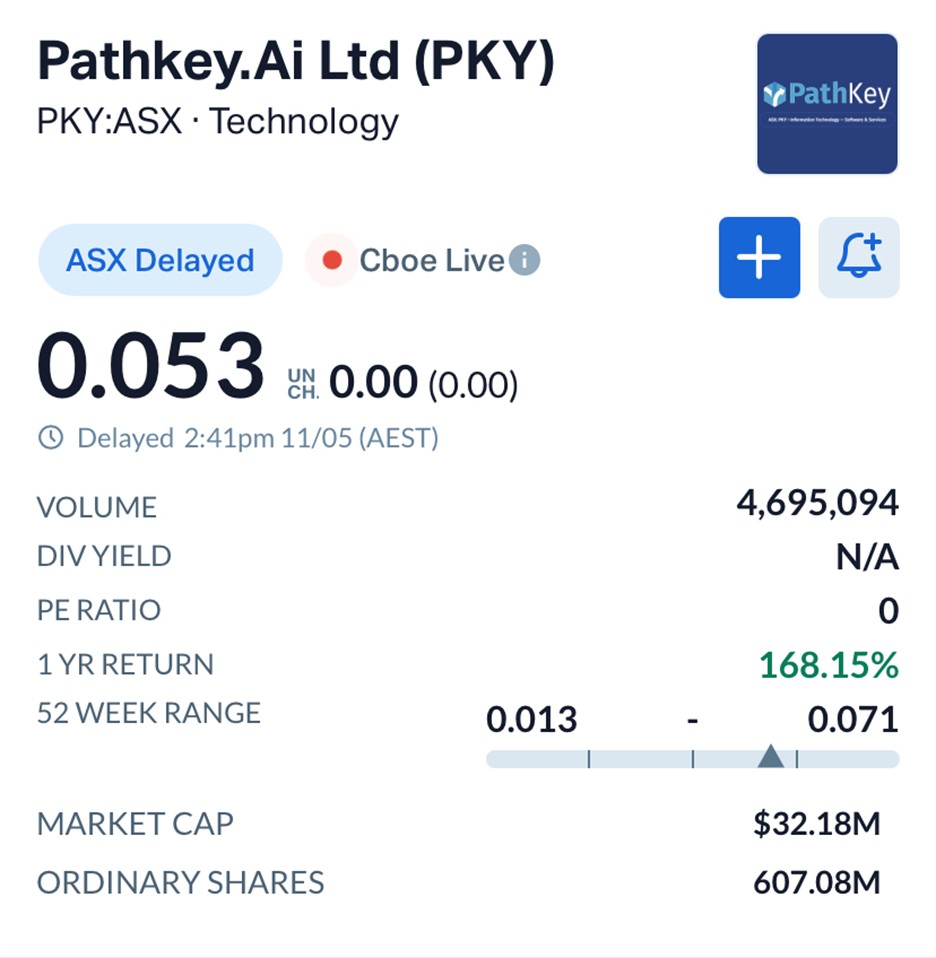
Source: MarketIndex
As governments and corporations grow increasingly cautious about where their data lives and who controls it, companies operating in secure AI infrastructure are becoming strategically valuable.
Pathkey appears determined to enter that race.
From biotech analytics to sovereign AI
For years, Pathkey.AI has largely been viewed as a niche health-tech business focused on clinical trial analytics.
Its flagship TrialKey platform uses artificial intelligence to help improve clinical trial efficiency, including patient selection and predictive analysis.
Now the company is broadening its ambitions well beyond healthcare.
Alongside TrialKey, Pathkey is also developing Chipforge, an AI-driven semiconductor design platform targeting one of the most competitive bottlenecks in global technology.
The semiconductor industry has become central to global economic policy following supply chain shocks, geopolitical tensions, and the explosive rise of generative AI systems.
Countries including the United States, China, Japan and members of the European Union are collectively investing hundreds of billions of dollars into domestic chip manufacturing and AI infrastructure projects.
Against that backdrop, Pathkey’s leadership change feels less like a routine executive appointment and more like a repositioning exercise.
The company appears to be transitioning from a software analytics player into a broader “sovereign AI” business focused on secure, high-value industries including defense, healthcare, and critical infrastructure.
Why Farnsworth matters
Andrew Farnsworth brings more than two decades of experience across defense systems, enterprise transformation, and secure communications.
His background spans both military and corporate environments, including senior work involving mission-critical IT systems and machine learning infrastructure.
Importantly, Farnsworth has already spent the past six months consulting with Pathkey.AI before formally stepping into the CEO role.
That matters because it reduces the execution risk often associated with external hires unfamiliar with a company’s technology or culture.
The board made clear the appointment was designed to accelerate Pathkey’s push into “data-sensitive industries,” particularly sectors where security and trust are as important as technological capability itself.
That means healthcare systems, defense agencies, and infrastructure operators increasingly wary of relying on generic AI platforms.
The incentives are tied to execution
One of the more interesting elements of the appointment is how heavily Farnsworth’s incentives are tied to commercial outcomes rather than market speculation.
His remuneration package includes a A$300,000 base salary plus 1.5 million sign-on shares and 18.2 million performance rights.
But those rights only vest if tangible milestones are achieved.
For TrialKey, the milestone involves securing a binding commercial partnership for ongoing platform use.
Stay ahead of the market
The most important stories, delivered to your inbox. No noise, just what matters.
By subscribing, you agree to our Privacy Policy.
For Chipforge, the hurdle is the successful delivery of a Minimum Viable Product within nine months, independently verified by an external expert.
Pathkey is attempting to shift focus away from theoretical AI potential and toward real-world execution.
In today’s technology environment, where many small-cap AI companies are long on ambition but short on revenue, that distinction matters.
The rise of “Sovereign AI”
The timing of the move also reflects a broader shift underway globally.
Over the past two years, governments and regulated industries have become increasingly concerned about dependence on foreign-controlled AI ecosystems.
The trend is giving rise to what analysts increasingly call “Sovereign AI.”
Rather than relying solely on mass-market AI systems, countries and enterprises are seeking secure, locally governed platforms capable of operating within strict regulatory and cybersecurity frameworks.
Australia itself has significantly increased defense and cyber spending in recent years as geopolitical tensions intensify across the Indo-Pacific region.
The opportunity lies in building specialized systems trusted by government and enterprise clients.
Pathkey appears to believe Farnsworth’s background can help bridge that gap.
What is your take on this story?
Disclaimer - Skrill Network is designed solely for educational and informational use. The content on this website should not be considered as investment advice or a directive. Before making any investment choices, it is crucial to carry out your own research, taking into account your individual investment objectives and personal situation. If you're considering investment decisions influenced by the information on this website, you should either seek independent financial counsel from a qualified expert or independently verify and research the information.