

The Great Disconnect: ASX Surges Past 9,100 Even as Inflation Refuses to Budge

Team Skrill Network
Team Skrill Network comprises seasoned professionals from diverse fields including Finance, Mining, Technology, Investing, and Digital Strategy. They bring a deep knowledge and understanding of financial markets and behavioural patterns to every story, ensuring credibility and precision in every piece. Whether analysing emerging market trends or spotlighting small- and mid-cap growth companies across ASX, TSX, or NASDAQ, the team’s editorial approach blends data-driven insights with compelling storytelling. Their expertise enables them to process complex developments into content that resonates with both institutional investors and retail audiences. Backed by experience in content curation, SEO strategy, and investor-focused messaging, the team of writers at Skrill Network are committed to delivering stories that matter—authentic, relevant, and strategically aligned with the evolving landscape of global investing.
Read more
Key Highlights:
- ASX 200 jumps 1.08% to 9,119.8 despite 3.8% inflation
- Trimmed mean CPI rises to 3.4%, complicating RBA outlook
- Tech and Staples lead gains, Utilities and Discretionary lag
- WiseTech and Woolworths power rally on margin protection
- Economists flag possible May rate hike to 4.1%
Australian households are still grappling with higher grocery bills and power costs. Yet on Wednesday, the share market told a very different story.
The S&P/ASX 200 climbed 1.08 percent to 9,119.8 points, comfortably cracking the 9,100 milestone. The rally came just hours after fresh data from the Australian Bureau of Statistics confirmed that headline inflation held steady at 3.8 percent for the year to January. More concerning for policymakers, trimmed mean inflation, which strips out volatile items, edged up to 3.4 percent from 3.3 percent.
Normally, persistent inflation would dampen enthusiasm on the trading floor. Instead, buyers stepped in.
Market Snapshot
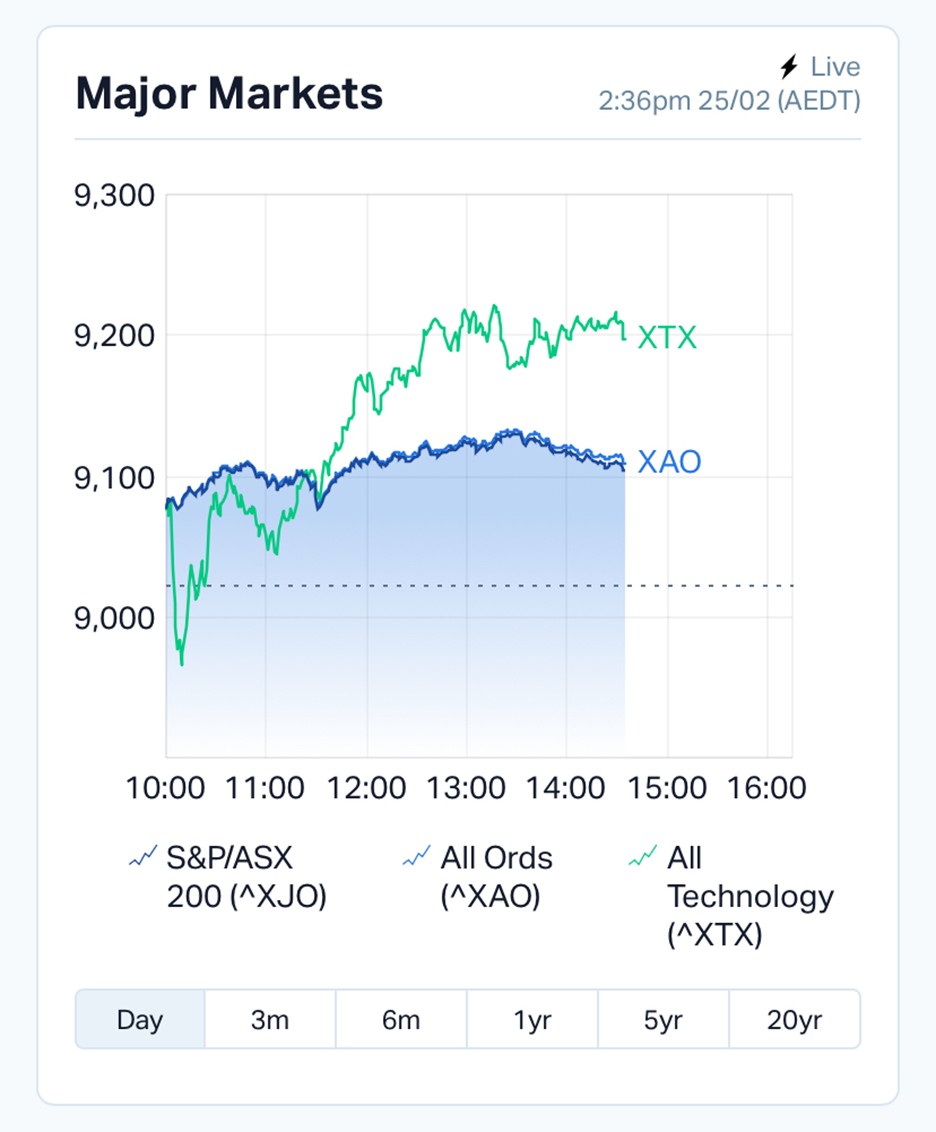
Source: MarketIndex
Inflation vs the Index
The disconnect is striking. Electricity costs surged 32.2 percent as subsidies washed out. Housing costs rose 6.8 percent. Services inflation remains sticky.
Yet equities surged.
Part of the answer lies in global momentum. Wall Street rebounded overnight after a volatile week tied to trade tensions and renewed tariff rhetoric. The S&P 500 rose 0.77 percent and the Nasdaq added 1.04 percent, buoyed by renewed optimism in the technology sector.
Australia followed the lead.
The local All Technology index jumped 3.99 percent to 2,695.3. The broader risk-on mood overshadowed domestic inflation concerns.
The Efficiency Trade
The day’s most powerful symbol of the new market logic was WiseTech Global Ltd, which soared 9.37 percent.
The logistics software company reported a 36 percent drop in net profit, largely linked to its $3.2 billion acquisition of e2open. Under normal circumstances, that headline might unsettle investors.
Instead, markets focused on management’s decision to cut 2,000 jobs over 18 months and pivot to an AI-first engineering model. CEO Zubin Appoo declared that the era of manually writing code is ending, signalling a structural shift toward automation.
The market rewarded lower future labour costs more than it punished short-term earnings pressure.
It reflects a broader trend. In 2026, the equity market is prioritising productivity and margin protection over headcount growth.
Inflation-Proof Giants
Another major contributor to the rally was Woolworths Group Ltd, which surged 10.91 percent.
The supermarket giant posted a 16.4 percent jump in underlying profit to $859 million. Net profit fell sharply after a $701 million remediation payment to underpaid staff, but investors focused on what matters most in an inflationary environment: pricing power.
Sales growth of 3.4 percent demonstrated that essential retailers can pass on higher costs. For households, that may feel painful. For shareholders, it signals resilience.
Staples rose 4.78 percent as a sector.
The message is clear. Companies selling essentials continue to protect margins, even when consumers tighten belts elsewhere.
The Consumer Divide
Not every business is benefiting.
Domino’s Pizza Enterprises Ltd fell 15.23 percent after reporting a 2.5 percent decline in same-store sales. The company has moved away from blanket discounting, but in a high inflation environment discretionary spending is under pressure.
The contrast between supermarkets and pizza chains highlights a growing divide. Essential goods providers are holding firm. Discretionary brands are struggling to defend volumes.
This split was evident across sectors. Utilities fell 1.46 percent, weighed down by rate sensitivity. Consumer discretionary lost 1.22 percent.
Signals from Abroad
Australia is not trading in isolation.
In the United States, markets are navigating renewed tariff rhetoric following President Donald Trump’s announcement of a proposed 15 percent global import tariff. Yet technology stocks have regained footing as investors await NVIDIA’s earnings and the State of the Union address.
The so-called HALO trade, heavy assets with low obsolescence risk, has regained traction after earlier volatility.
Meanwhile, the Australian dollar strengthened to 70.8 US cents, reflecting expectations that the Reserve Bank of Australia may not be finished tightening policy.
The RBA Dilemma
Economists at Capital Economics and Commonwealth Bank now argue that a May rate hike to 4.1 percent remains firmly in play.
Stay ahead of the market
The most important stories, delivered to your inbox. No noise, just what matters.
By subscribing, you agree to our Privacy Policy.
Trimmed mean inflation rising to 3.4 percent complicates the central bank’s path. Services inflation remains persistent, and housing cost growth continues to exert pressure.
Yet financial markets appear comfortable for now.
The ASX VIX index sits at 11.7, signalling low expected volatility over the next 30 days. Traders are effectively betting that rate risk is manageable in the near term.
Some in the market describe it as a buy now, reassess in May mindset.
A K-Shaped Reality
The divergence between consumer hardship and corporate strength is becoming more visible.
For households, inflation remains elevated. Mortgage stress and higher utility bills are tangible.
For listed companies, automation and pricing power are preserving margins. Cash flows remain solid across key sectors, and global liquidity is flowing back into equities after bouts of volatility in 2025.
The ASX’s move above 9,100 is not occurring despite inflation. In many cases, it is occurring because companies have adapted to it.
What Happens Next
The coming weeks will test the rally’s durability. If inflation fails to moderate further and the RBA signals a firmer tightening bias, sentiment could shift quickly.
For now, global tech momentum, strong earnings from defensive names and renewed appetite for risk are outweighing macro caution.
The disconnect may feel uncomfortable. But markets do not always mirror the lived economy in real time.
Sometimes they move ahead of it.
What is your take on this story?
This is user sentiment & not financial advice.
Disclaimer - Skrill Network is designed solely for educational and informational use. The content on this website should not be considered as investment advice or a directive. Before making any investment choices, it is crucial to carry out your own research, taking into account your individual investment objectives and personal situation. If you're considering investment decisions influenced by the information on this website, you should either seek independent financial counsel from a qualified expert or independently verify and research the information.