


US and European Defense Stocks Rise as Greenland Tensions Grow

Team Skrill Network
Team Skrill Network comprises seasoned professionals from diverse fields including Finance, Mining, Technology, Investing, and Digital Strategy. They bring a deep knowledge and understanding of financial markets and behavioural patterns to every story, ensuring credibility and precision in every piece. Whether analysing emerging market trends or spotlighting small- and mid-cap growth companies across ASX, TSX, or NASDAQ, the team’s editorial approach blends data-driven insights with compelling storytelling. Their expertise enables them to process complex developments into content that resonates with both institutional investors and retail audiences. Backed by experience in content curation, SEO strategy, and investor-focused messaging, the team of writers at Skrill Network are committed to delivering stories that matter—authentic, relevant, and strategically aligned with the evolving landscape of global investing.
Read more
Key Highlights
- Wall Street holds near record highs as jobs data and geopolitics compete for attention
- Greenland emerges as a new flashpoint, lifting European and U.S. Defense stocks
- Denmark commits $13.8bn to Arctic defense as security concerns deepens
- Aerospace and defense shares surge on expectations of sustained military spending
U.S. Markets traded cautiously on Wednesday, January 7, as Wall Street balanced strong momentum from record highs against fresh geopolitical uncertainty tied to Greenland and renewed shifts in global defense policy.
Futures on the S&P 500 and Nasdaq wavered after the benchmark index closed at an all-time high in the previous session, while Dow futures edged higher after the blue-chip index pushed past the 49,000 mark for the first time. Market participants were digesting weaker-than-expected U.S. private payrolls data alongside new geopolitical developments in Europe and the Arctic.
According to ADP, U.S. private employers added 41,000 jobs in December, undershooting expectations. ADP chief economist Nela Richardson said the data pointed to “a labor market losing momentum into year-end,” setting the stage for Friday’s closely watched U.S. jobs report.
Market Snapshot
At the same time, geopolitical risk has returned to the foreground.
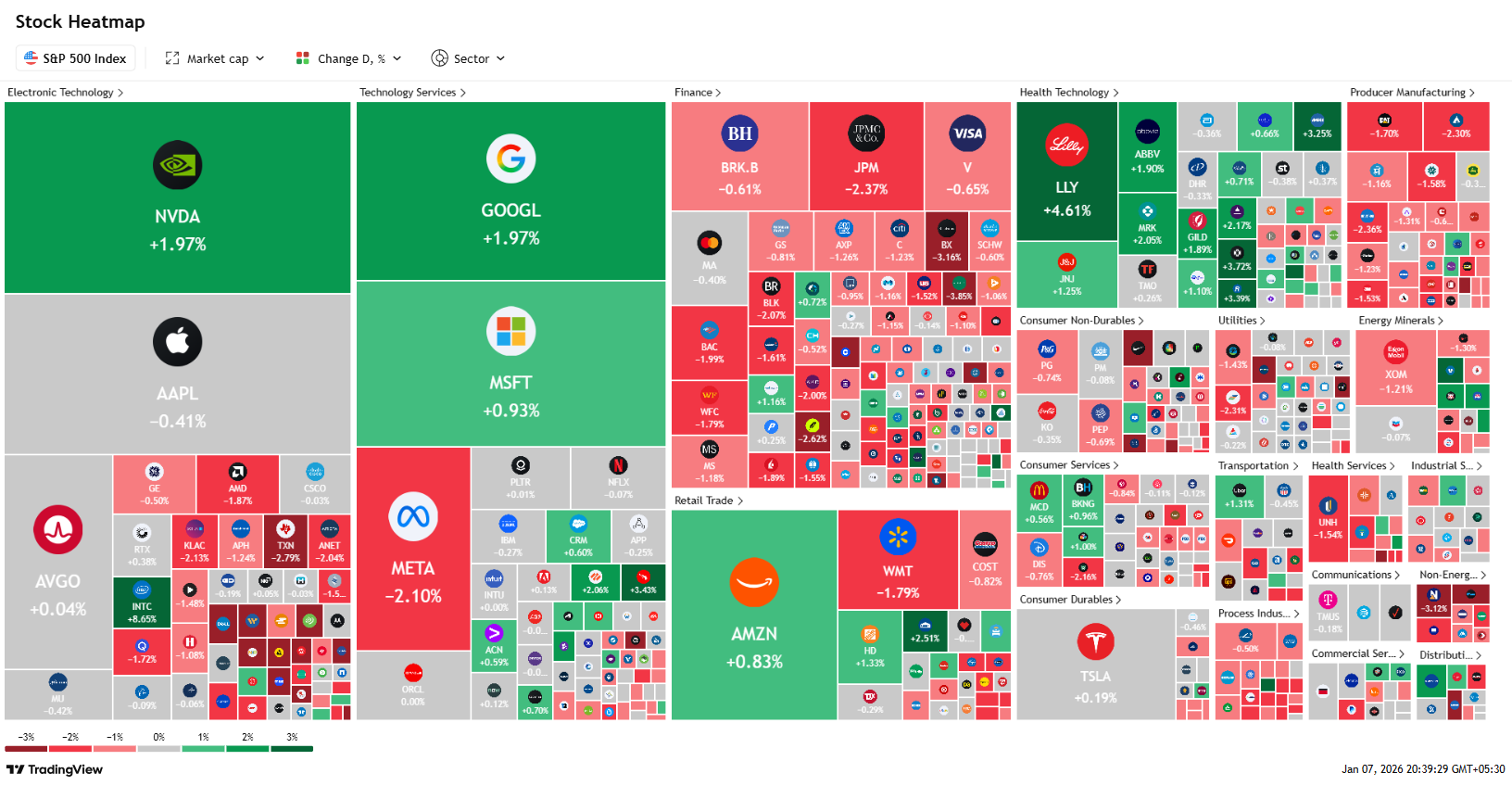
Sorce: TradingView
Greenland Moves From Geography to Geopolitics
Global attention shifted sharply to Greenland following comments from U.S. President Donald Trump, who said Washington was considering “a range of options” to secure the Arctic territory, including potential military involvement.
White House press secretary Karoline Leavitt confirmed to CNBC that national security considerations were central to the administration’s thinking, as the U.S. weighs growing Russian and Chinese activity in the Arctic.
European leaders responded swiftly. Both Denmark and Greenland reiterated that the territory is not for sale, while Denmark announced a significant escalation in defense spending tied directly to Arctic security.
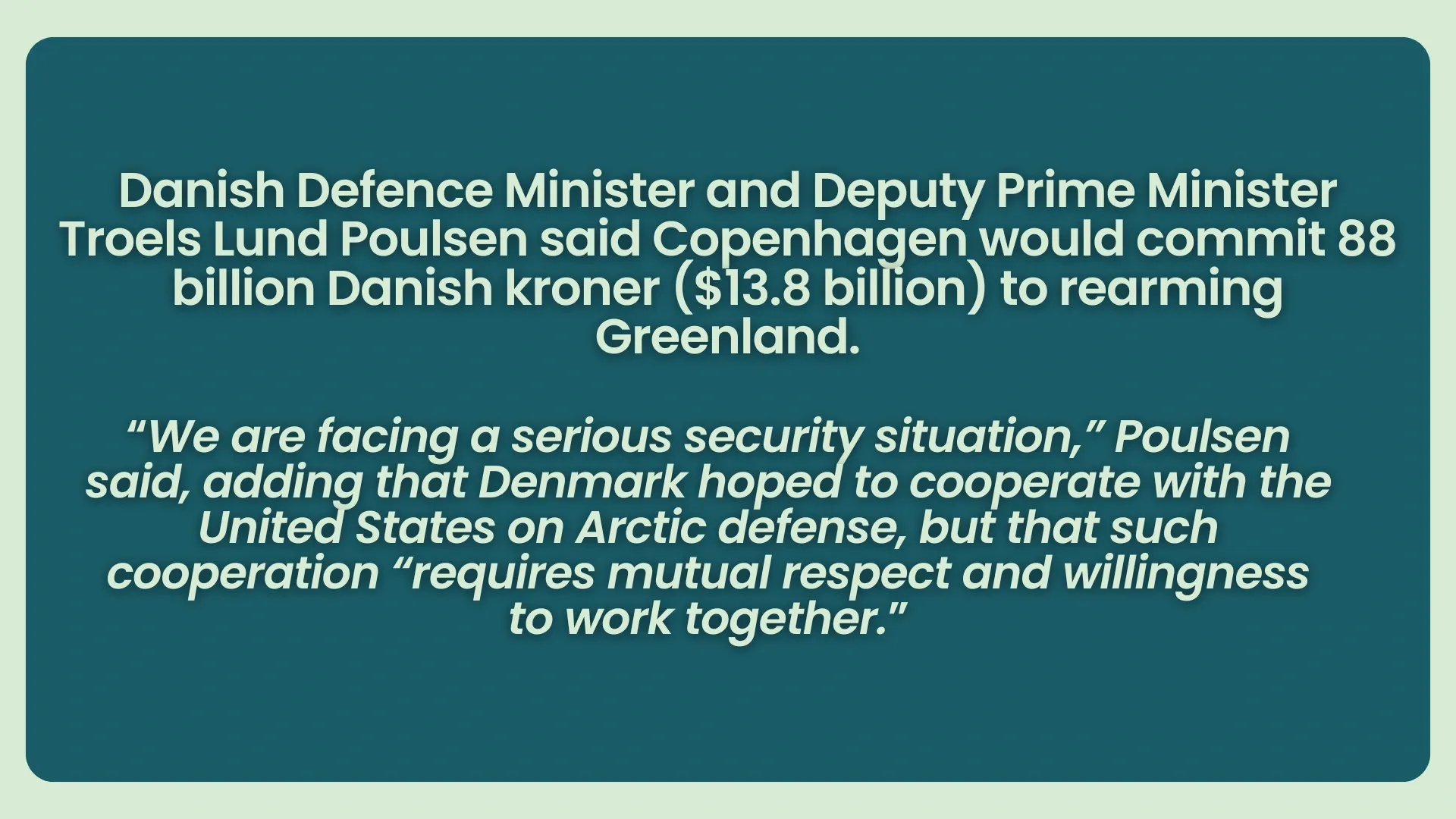
Source: CNBC, January 7, 2026
The announcement helped crystallize what markets had already begun to price in: a new, long-term defense spending cycle centered on Arctic security.
European Defense Stocks Extend Rally
European equities were mixed overall, with the Stoxx Europe 600 trading slightly lower by mid-session. Beneath the surface, however, defense stocks continued to outperform.
The Stoxx Europe Aerospace and Defense index rose 1.6%, marking its fourth consecutive day of gains, according to market data.
Several European defense names posted sharp single-day moves, reflecting expectations of sustained procurement and modernization programs:
Avon Technologies surged over 40%, leading the sector
Leonardo climbed more than 18%
Hensoldt gained nearly 14%
MTU Aero Engines, Chemring Group, and Thales also advanced solidly
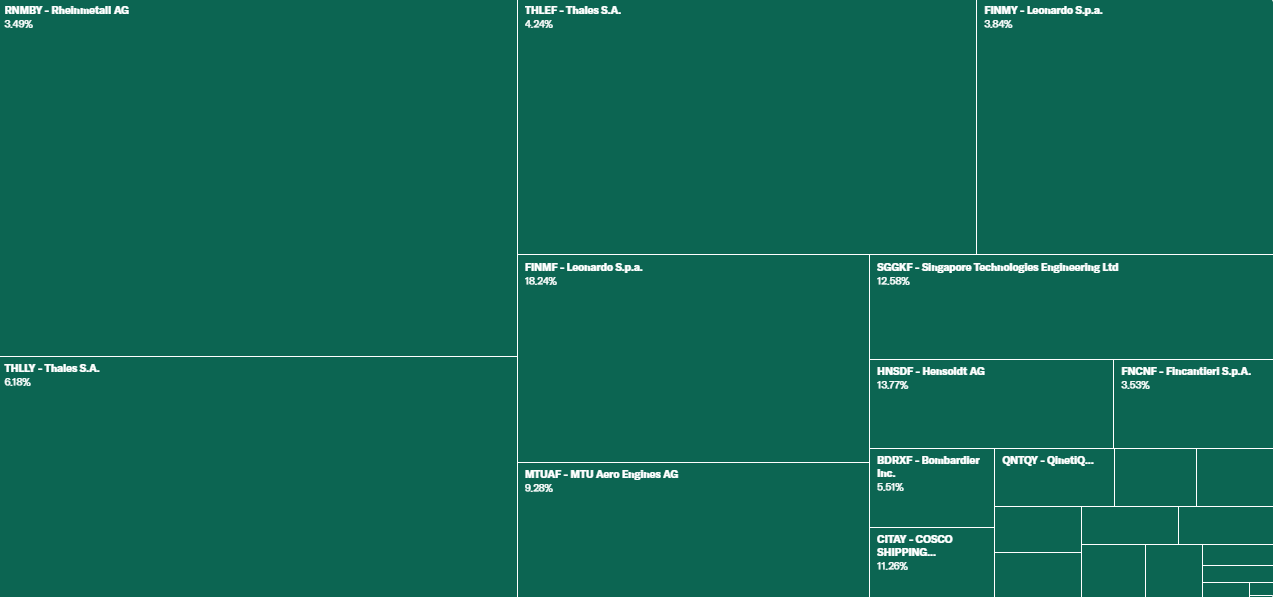
AEROSPAVE AND DEFENSE STOCKS - Source: YAHOO FINANCE
The rally reflects a clear market message: defense is no longer a short-term geopolitical hedge, but a structural theme tied to national security priorities.
U.S. Defense Stocks Follow Suit
The same narrative is playing out in the United States.
According to sector data, the U.S. aerospace and defense industry now carries a combined market capitalization of $1.72 trillion, with the sector up 54% over the past year, far outpacing the broader S&P 500.
Large U.S. defense primes such as Lockheed Martin, RTX, Northrop Grumman, and General Dynamics continued to attract steady buying, while smaller and mid-cap names saw sharper percentage moves.
Among the top movers on the day:
Momentus Inc. jumped over 29% on elevated volume
Avon Technologies and Leonardo posted double-digit gains
QinetiQ, Fincantieri, and BAE Systems also advanced
Yahoo Finance data shows the aerospace and defense industry has delivered 182% returns over five years, underlining how geopolitical risk has translated into sustained earnings visibility.
Stay ahead of the market
The most important stories, delivered to your inbox. No noise, just what matters.
By subscribing, you agree to our Privacy Policy.
Why Defense Stocks Are Rising Now
The current rally is being driven by a convergence of macro and micro forces:
First, geopolitical flashpoints are multiplying, from Eastern Europe to the Arctic, pushing governments to accelerate defense spending rather than defer it.
Second, Denmark’s Greenland decision reinforces a broader NATO trend: Arctic defense is now a priority, not a contingency.
Third, U.S. defense contractors are benefiting from long-dated contracts, higher backlog visibility, and bipartisan support for military modernization.
As President Trump framed it earlier this week, Arctic security is no longer optional. He has repeatedly argued that Greenland is vital to U.S. national security, citing increased activity by Russia and China in the region.
Global Markets: Mixed, But Watching Defense Closely
Outside defense, global markets remained mixed.
Asian markets were uneven, European indices were split, and commodities softened, with oil prices falling below $60 a barrel after Trump said Venezuela would send up to 50 million barrels of crude to the U.S.
Meanwhile, technology remained in focus at CES 2026, where comments from Nvidia’s Jensen Huang about “unserved demand” in AI data storage helped lift semiconductor sentiment, according to Bloomberg.
Still, defense stocks stood apart as one of the clearest themes of the session.
The Bigger Picture
What markets are signaling is not just a reaction to headlines, but a recalibration of global priorities.
Greenland has become a symbol of a wider shift, where geography, energy routes, and national security intersect. For defense companies, that shift translates into higher budgets, longer contracts, and renewed strategic relevance.
As Denmark, the U.S., and NATO reassess Arctic security, markets are doing the same.
What is your take on this story?
This is user sentiment & not financial advice.
Disclaimer - Skrill Network is designed solely for educational and informational use. The content on this website should not be considered as investment advice or a directive. Before making any investment choices, it is crucial to carry out your own research, taking into account your individual investment objectives and personal situation. If you're considering investment decisions influenced by the information on this website, you should either seek independent financial counsel from a qualified expert or independently verify and research the information.