

The Regulatory Breakthrough: ASX Battery Pioneer Clears the Path for US Defense Supply

Team Skrill Network
Team Skrill Network comprises seasoned professionals from diverse fields including Finance, Mining, Technology, Investing, and Digital Strategy. They bring a deep knowledge and understanding of financial markets and behavioural patterns to every story, ensuring credibility and precision in every piece. Whether analysing emerging market trends or spotlighting small- and mid-cap growth companies across ASX, TSX, or NASDAQ, the team’s editorial approach blends data-driven insights with compelling storytelling. Their expertise enables them to process complex developments into content that resonates with both institutional investors and retail audiences. Backed by experience in content curation, SEO strategy, and investor-focused messaging, the team of writers at Skrill Network are committed to delivering stories that matter—authentic, relevant, and strategically aligned with the evolving landscape of global investing.
Read more
Key Highlights
- Li-S Energy secures Australian and US approvals to airfreight lithium-sulfur battery cells
- Regulatory clearance opens direct access to US aerospace and defence customers
- Company targeting drones, unmanned systems and electric aviation markets
- Lithium-sulfur technology offers more than double the energy density of conventional lithium-ion batteries
- Shares in Li-S Energy climbed 8.33% on Wednesday afternoon
Li-S Energy (ASX: LIS) has cleared one of the most difficult hurdles facing next-generation battery companies: getting its technology onto a plane and into the United States.
The Australian battery developer announced it had secured dual regulatory approvals from the Civil Aviation Safety Authority in Australia and the US Pipeline and Hazardous Materials Safety Administration, allowing its lithium-sulfur battery cells to be transported by air into the US market.
For most industries, that may sound procedural.
Market Snapshot
For battery developers targeting aerospace and defence, it can change the commercial equation entirely.
Lithium-based batteries are tightly regulated under dangerous goods rules because of fire and transport safety risks. Emerging battery chemistries face even greater scrutiny, particularly during early-stage commercialisation when products are still moving through testing and validation programs.
Without airfreight approval, prototype battery cells are often restricted to sea freight, adding weeks or months to delivery schedules.
That delay matters in industries built around rapid iteration.
US defence contractors, aerospace developers and drone manufacturers increasingly expect suppliers to participate in fast-moving prototyping cycles where battery performance, payload efficiency and flight duration are constantly refined.
Li-S Energy now has the ability to physically deliver its technology into that ecosystem.
The company said the approvals were a prerequisite for securing significant supply agreements in the United States, effectively shifting the business from technical engagement toward commercial execution.
The timing also aligns with growing Western demand for sovereign battery technologies tied to defence and critical infrastructure.
The United States, Australia and the United Kingdom have all accelerated investment into advanced energy systems under the AUKUS framework, particularly technologies relevant to unmanned systems, autonomous defence platforms and electric aviation.
That is where lithium-sulfur chemistry is attracting attention.
Traditional lithium-ion batteries dominate global energy storage, but they are approaching physical limitations in energy density. Lithium-sulfur batteries offer the potential for substantially lighter weight cells while storing more energy.
Lighter batteries can extend drone flight times, increase payload capacity or reduce system weight. Those advantages become strategically important in military reconnaissance drones, long-range unmanned aerial systems and electric aerospace applications.
Li-S Energy says its batteries can deliver more than double the energy density of conventional lithium-ion technologies.
The company is already using Paladin Defence Services as its US representative, helping establish pathways into American defence procurement channels.
Wednesday’s regulatory update effectively strengthens that bridge.
The broader March quarterly report also showed a business moving beyond pure laboratory development.
Li-S Energy spent the quarter refining pouch cell formation processes and building the operational systems needed to support a larger partner network.
The company described the period as one focused on scaling operational infrastructure alongside technical progress.
That distinction matters in battery manufacturing.
History across the battery sector has shown that moving from prototype success to reliable commercial production is often where emerging developers struggle. Aerospace and defence customers, in particular, require consistency, traceability and quality assurance across every production stage.
Li-S Energy’s quarterly update highlighted ongoing work around reliability and process control, areas that typically become essential before commercial contracts are secured.
The next major milestone is UN38.3 certification, an internationally recognised transport standard for lithium batteries.
Once completed, the certification would allow larger commercial shipments under standard logistics classifications and could materially simplify export operations into global markets.
The company’s latest approvals may also create what analysts describe as a regulatory moat.
Few early-stage battery companies possess both the safety data and operational controls required to secure air transport approvals across multiple jurisdictions.
Stay ahead of the market
The most important stories, delivered to your inbox. No noise, just what matters.
By subscribing, you agree to our Privacy Policy.
That can create a practical barrier to entry, particularly in sectors where delivery speed and logistics reliability directly influence customer adoption.
Markets responded positively to the update.
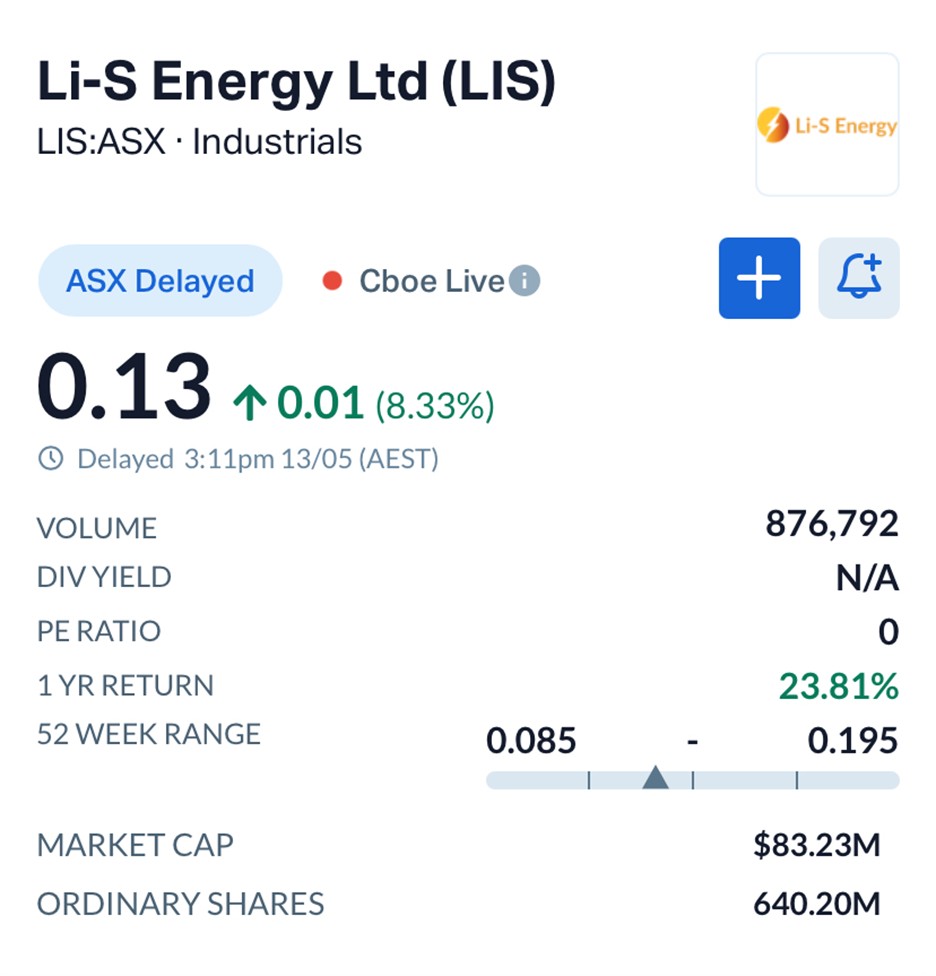
Li-S Energy shares rose 8.33 per cent to 13 cents in Wednesday afternoon trade, valuing the company at approximately $83 million.
Source: MarketIndex
The move extends growing interest in ASX-listed defence and battery technology stocks as geopolitical tensions reshape supply chain priorities across Western economies.
Governments are increasingly searching for alternatives to concentrated battery supply chains dominated by Asia, while defence agencies are placing greater emphasis on lightweight energy systems capable of supporting autonomous platforms.
Li-S Energy is still in the development phase.
But today’s announcement suggests the company has crossed an important threshold.
The challenge is no longer simply proving the battery works.
It is now about proving the company can deliver it into one of the world’s most demanding industrial and defence markets at commercial speed.
What is your take on this story?
This is user sentiment & not financial advice.
Disclaimer - Skrill Network is designed solely for educational and informational use. The content on this website should not be considered as investment advice or a directive. Before making any investment choices, it is crucial to carry out your own research, taking into account your individual investment objectives and personal situation. If you're considering investment decisions influenced by the information on this website, you should either seek independent financial counsel from a qualified expert or independently verify and research the information.