


Vitrafy (ASX: VFY) Smashes Global Benchmarks as US Military Study Validates “No-Wash” Blood Preservation Tech

Team Skrill Network
Team Skrill Network comprises seasoned professionals from diverse fields including Finance, Mining, Technology, Investing, and Digital Strategy. They bring a deep knowledge and understanding of financial markets and behavioural patterns to every story, ensuring credibility and precision in every piece. Whether analysing emerging market trends or spotlighting small- and mid-cap growth companies across ASX, TSX, or NASDAQ, the team’s editorial approach blends data-driven insights with compelling storytelling. Their expertise enables them to process complex developments into content that resonates with both institutional investors and retail audiences. Backed by experience in content curation, SEO strategy, and investor-focused messaging, the team of writers at Skrill Network are committed to delivering stories that matter—authentic, relevant, and strategically aligned with the evolving landscape of global investing.
Read more
Key Highlights
- Vitrafy shares rose 9.40% to A$2.56 after Phase II US military-backed study results
- “No-Wash” platelet preservation protocol achieved 94.4% post-thaw recovery
- Results comfortably exceeded the global 50% regulatory quality threshold
- Study conducted under formal agreement with the U.S. Army Institute of Surgical Research
- FDA registration pathway and commercial scaling targeted for H1 FY2027
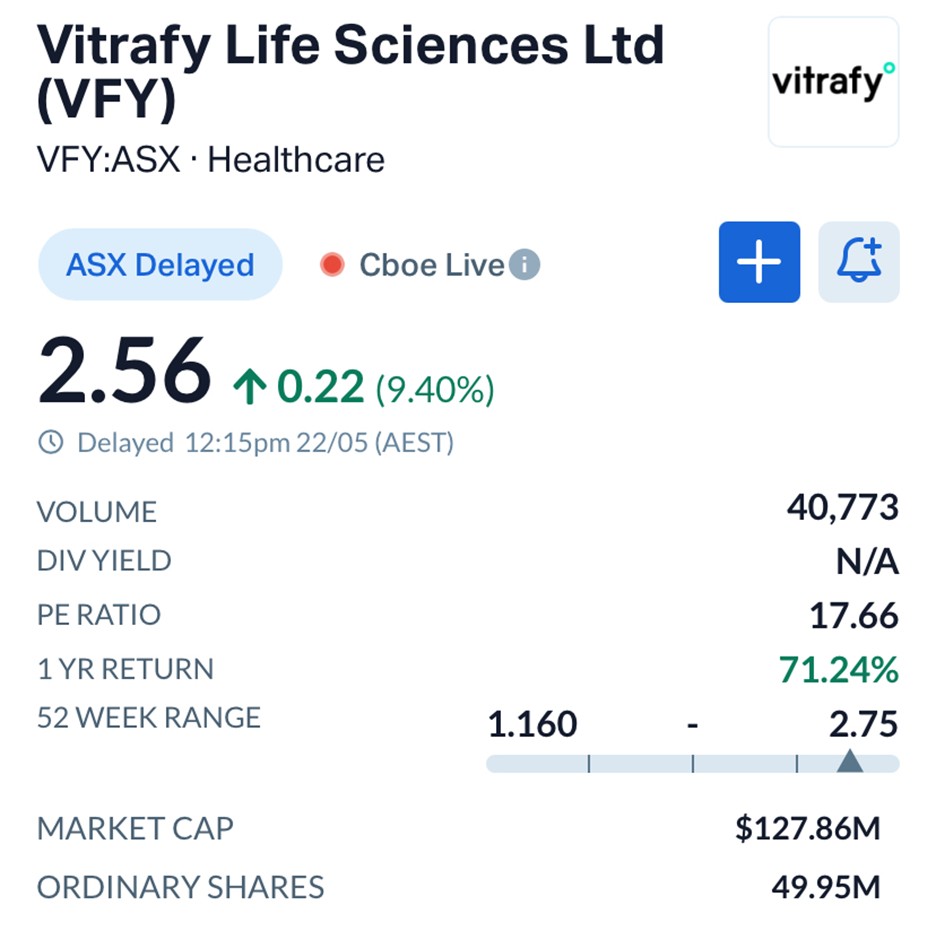
The healthcare sector found a fresh pocket of momentum on Friday as VFY climbed 9.40% after unveiling final Phase II results from a major U.S. military-backed blood preservation study.
Vitrafy Life Sciences closed in on its 52-week high after reporting that its proprietary “No-Wash” cryopreservation technology significantly outperformed legacy blood storage methods in commercial-scale platelet testing conducted by the U.S. Army Institute of Surgical Research (USAISR).
The stock traded at A$2.56 by late morning, lifting the company’s market value to roughly A$125 million. Over the past year, shares have climbed more than 70%, reflecting growing interest in medical technologies linked to battlefield medicine, emergency response systems, and next-generation blood logistics.
Market Snapshot
Source: MarketIndex
At the centre of the announcement was Vitrafy’s 3% DMSO “No-Wash” protocol, which recorded a post-thaw platelet recovery rate of 94.4%. That figure sharply exceeded the 50% benchmark typically used in global blood preservation standards.
Traditional cryopreservation systems often rely on higher concentrations of chemical agents that must later be manually removed before transfusion. The washing process can damage platelets, slow emergency deployment, and require specialised laboratory infrastructure.
Vitrafy’s approach removes that step entirely.
The company’s data also showed stronger clot performance and higher receptor retention than legacy methods, metrics closely tied to how effectively preserved platelets function inside the human body.
Under the comparative study:
- The 3% DMSO “No-Wash” protocol achieved 94.4% platelet recovery
- Legacy 6% DMSO wash-based methods delivered 83.8%
- Trehalose-based “No-Wash” protocols recorded 78.9%
The study involved platelets from 20 separate donors and more than 60 split-sample tests, making it one of the largest independent commercial-format platelet cryopreservation studies conducted under military oversight.
Vitrafy said the program was executed through a Cooperative Research and Development Agreement with the U.S. Army, aimed at supporting rapid deployment blood logistics in battlefield and remote medical environments.
The military angle is becoming increasingly important in the broader healthcare and biotech sector.
Modern defence agencies are investing heavily into deployable medical systems capable of functioning in contested environments where refrigeration, transport infrastructure, and rapid blood resupply can become unreliable. Blood platelets traditionally have extremely short shelf lives, creating major operational bottlenecks during conflicts and natural disasters.
Vitrafy is positioning its technology as a solution to that problem.
Management said the successful Phase II validation now clears a major commercial and regulatory milestone first outlined during the company’s 2024 IPO process.
The company is now preparing for FDA medical device registration for its GUARDION platform during H1 FY2027, alongside publication of the U.S. Army-authored scientific results in military and civilian journals.
Vitrafy Managing Director and Chief Executive Officer Dr Paul Lucey said the latest data represented a major advancement in blood logistics technology.
Stay ahead of the market
The most important stories, delivered to your inbox. No noise, just what matters.
By subscribing, you agree to our Privacy Policy.
“The results from this Phase II study demonstrate that our cryopreservation system can preserve platelet quality at levels significantly above global benchmarks while eliminating the need for post-thaw washing,” Dr Lucey said.
“That has important implications not only for military medicine, but also for civilian blood banking networks where speed, portability and usability are becoming increasingly critical.”
The broader commercial opportunity extends beyond defence channels.
Global blood banking operators are under pressure to modernise ageing cold-storage infrastructure while improving access to platelets in regional hospitals, trauma centres, and disaster-response systems. Longer-life, deployment-ready platelet inventories are increasingly viewed as a strategic healthcare priority across both military and civilian networks.
Vitrafy’s technology now enters that conversation with third-party validation attached to it.
For the market, Friday’s move was not simply about another biotech data release. The scale of the U.S. Army involvement, the unusually strong recovery metrics, and the removal of operational bottlenecks appear to have shifted the discussion from laboratory theory toward practical deployment.
With FDA pathways now approaching and military publication timelines locked in, the next phase for Vitrafy may depend less on proving the science and more on proving how quickly the healthcare system is willing to adopt it.
What is your take on this story?
This is user sentiment & not financial advice.
Disclaimer - Skrill Network is designed solely for educational and informational use. The content on this website should not be considered as investment advice or a directive. Before making any investment choices, it is crucial to carry out your own research, taking into account your individual investment objectives and personal situation. If you're considering investment decisions influenced by the information on this website, you should either seek independent financial counsel from a qualified expert or independently verify and research the information.



%2520Up%2520676%2525%2520in%252012%2520Months%2520Forrest%2520Stake%2520Trade%2520Sparks%252065M%2520Share%2520Buying%2520Frenzy.png&w=3840&q=75)