


Why AnteoTech (ASX: ADO) Stock Surged 38% Today: The Silicon Anode Breakthrough Unlocking the Drone Economy

Team Skrill Network
Team Skrill Network comprises seasoned professionals from diverse fields including Finance, Mining, Technology, Investing, and Digital Strategy. They bring a deep knowledge and understanding of financial markets and behavioural patterns to every story, ensuring credibility and precision in every piece. Whether analysing emerging market trends or spotlighting small- and mid-cap growth companies across ASX, TSX, or NASDAQ, the team’s editorial approach blends data-driven insights with compelling storytelling. Their expertise enables them to process complex developments into content that resonates with both institutional investors and retail audiences. Backed by experience in content curation, SEO strategy, and investor-focused messaging, the team of writers at Skrill Network are committed to delivering stories that matter—authentic, relevant, and strategically aligned with the evolving landscape of global investing.
Read more
Key Highlights
- AnteoTech shares surged 38.46% to $0.018 on massive trading volume
- Independent US testing validated the company’s Ultranode™ 95 battery technology
- Technology achieved over 390 Wh/kg energy density in commercial-format cells
- Results exceeded military drone performance thresholds
- Joint development discussions with US battery groups are now advancing
AnteoTech (ASX: ADO) became one of the ASX’s standout movers on Thursday after the battery materials developer delivered a breakthrough that pushed its shares up 38.46% to $0.018 by early afternoon trade.
More than 170 million shares changed hands as the market reacted to independent US validation of the company’s Ultranode™ 95 silicon anode technology.
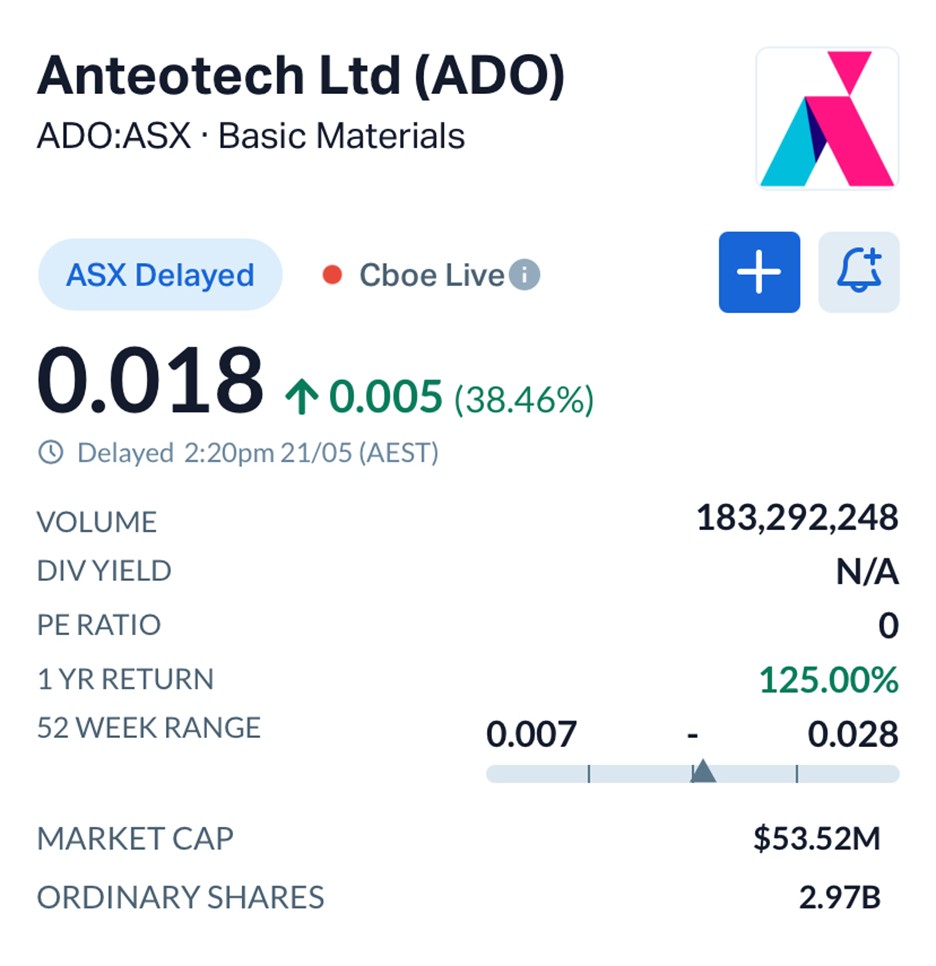
Market Snapshot
Source: MarketIndex
The announcement marks a significant step for AnteoTech, which has spent years attempting to commercialise high-silicon lithium-ion battery technology capable of dramatically improving energy density while lowering manufacturing costs.
This time, the market response suggested investors believe the technology may finally be moving beyond the laboratory.
The breakthrough that moved the stock
The catalyst came from testing conducted at the Battery Innovation Center (BIC) in Indiana, one of the better-known battery commercialisation facilities in the United States.
BIC successfully integrated Ultranode™ 95 into 5Ah commercial-format multi-layer pouch cells, validating that the material can function within scalable manufacturing environments rather than just controlled laboratory conditions.
The results were strong enough to immediately shift attention toward potential commercial deployment across the rapidly expanding drone and defence sectors.
According to the company, the battery configuration delivered energy density exceeding 390 Wh/kg at the cell level, roughly 40% higher than conventional graphite anode systems commonly used today.
The cells also achieved more than 300 charge cycles while retaining 70% capacity, surpassing performance thresholds typically required for Western military drone applications.
Silicon has long promised a battery revolution
For years, battery developers have pursued silicon anodes because silicon can theoretically store far more lithium ions than graphite.
The challenge has always been stability.
Silicon tends to expand and degrade during repeated charging cycles, making large-scale commercial adoption difficult.
AnteoTech believes it has addressed that bottleneck using a lower-cost micro-silicon formulation rather than expensive silane-derived silicon-carbon composites used by many competitors.
The economics caught attention almost as quickly as the performance metrics.
The company estimates its raw material costs sit between US$10 and US$25 per kilogram, compared with some competing silicon materials priced as high as US$200 per kilogram.
That cost profile matters in an industry where scale and manufacturing efficiency often determine whether promising chemistry ever reaches commercial markets.
Management signals commercial discussions are advancing
AnteoTech Managing Director and CEO Merrill Gray described the independent validation as a major turning point for the company’s commercialisation pathway.
“The successful independent third-party validation of Ultranode™ 95 in a commercial-format Multi-Layer Pouch cell is an important milestone in our scale-up and commercialisation pathway,” Gray said.
“It demonstrates both the manufacturability and performance potential of Ultranode™ 95 in commercial battery formats.”
Gray also confirmed the company has already produced roll-to-roll samples that will now be supplied to two US-based groups currently involved in Joint Development Agreement discussions.
“We have agreed that this step establishes the basis for us to move forward with the JDAs,” he added.
The drone economy is becoming a major battery battleground
The timing of the announcement aligns with a sharp increase in global defence and drone-related spending.
Western governments are actively searching for battery supply chains less dependent on China, particularly after recent export restrictions tied to graphite and advanced battery materials.
In the United States, the recently introduced SkyFoundry Act aims to dramatically scale domestic drone manufacturing capacity.
Stay ahead of the market
The most important stories, delivered to your inbox. No noise, just what matters.
By subscribing, you agree to our Privacy Policy.
Europe is also accelerating spending under various autonomous defence and border security initiatives.
That shift has transformed battery technology into a strategic national security issue rather than simply a consumer electronics story.
The global drone battery market is currently estimated at between US$8 billion and US$9.5 billion annually and is projected to expand rapidly over the next decade as military, logistics and industrial drone adoption increases.
Why the market reacted so aggressively
Small-cap technology companies regularly publish promising test results, but markets rarely respond with a 42% rally unless investors sense commercial inflection points are approaching.
In AnteoTech’s case, three factors appeared to drive the buying surge.
First, the validation came from an independent US facility rather than internal company testing.
Second, the testing confirmed scalability into commercial battery formats, reducing fears that the chemistry would fail outside laboratory environments.
Third, the company is already progressing discussions with potential US partners tied to the defence and UAV ecosystem.
The next catalyst may not be far away either.
AnteoTech confirmed that BIC has already started fabricating 18650 cylindrical cells, one of the most widely used battery formats globally across drones, robotics and consumer electronics.
What is your take on this story?
This is user sentiment & not financial advice.
Disclaimer - Skrill Network is designed solely for educational and informational use. The content on this website should not be considered as investment advice or a directive. Before making any investment choices, it is crucial to carry out your own research, taking into account your individual investment objectives and personal situation. If you're considering investment decisions influenced by the information on this website, you should either seek independent financial counsel from a qualified expert or independently verify and research the information.