


Why Big Money is Transforming the ASX Resource Sector Today

Team Skrill Network
Team Skrill Network comprises seasoned professionals from diverse fields including Finance, Mining, Technology, Investing, and Digital Strategy. They bring a deep knowledge and understanding of financial markets and behavioural patterns to every story, ensuring credibility and precision in every piece. Whether analysing emerging market trends or spotlighting small- and mid-cap growth companies across ASX, TSX, or NASDAQ, the team’s editorial approach blends data-driven insights with compelling storytelling. Their expertise enables them to process complex developments into content that resonates with both institutional investors and retail audiences. Backed by experience in content curation, SEO strategy, and investor-focused messaging, the team of writers at Skrill Network are committed to delivering stories that matter—authentic, relevant, and strategically aligned with the evolving landscape of global investing.
Read more
Key Highlights
- Northern Minerals faces forced foreign divestment order tied to critical minerals security
- Treasurer orders sale of 17.5% stake linked to foreign-backed entities
- Challenger Gold secures A$85 million institutional placement
- Mining heavyweight Peter Marrone joins Challenger Gold as Chairman-elect
- Resource capital increasingly flowing toward strategic and development-ready assets
The Australian resource sector is beginning to look less like a traditional commodity market and more like a geopolitical battleground.
On one side sit governments trying to secure supply chains for critical minerals tied to defense, robotics and electric vehicles. On the other are institutional investors pouring fresh capital into projects that already carry the scale, leadership and financing needed to move toward production.
That shift was on full display across the ASX on Monday.
Market Snapshot
Northern Minerals and Challenger Gold delivered two very different announcements, but both pointed toward the same conclusion: capital is increasingly concentrating around strategic alignment and advanced-stage development.
Northern Minerals (ASX: NTU) spent the session under heavy scrutiny after Federal Treasurer Dr Jim Chalmers ordered six foreign-linked entities to divest their combined 17.5 per cent stake in the company within 14 days.
The order impacts shareholders including Hong Kong Ying Tak, Real International Resources, Qogir Trading and Service Co., Vastness Investment Group, Chuanyou Cong and Shongxiong Lin.
Together, the holdings are worth roughly A$40 million.
Shares in Northern Minerals slipped 6.25 per cent to 2.3 cents by midday, with more than 49 million shares changing hands.
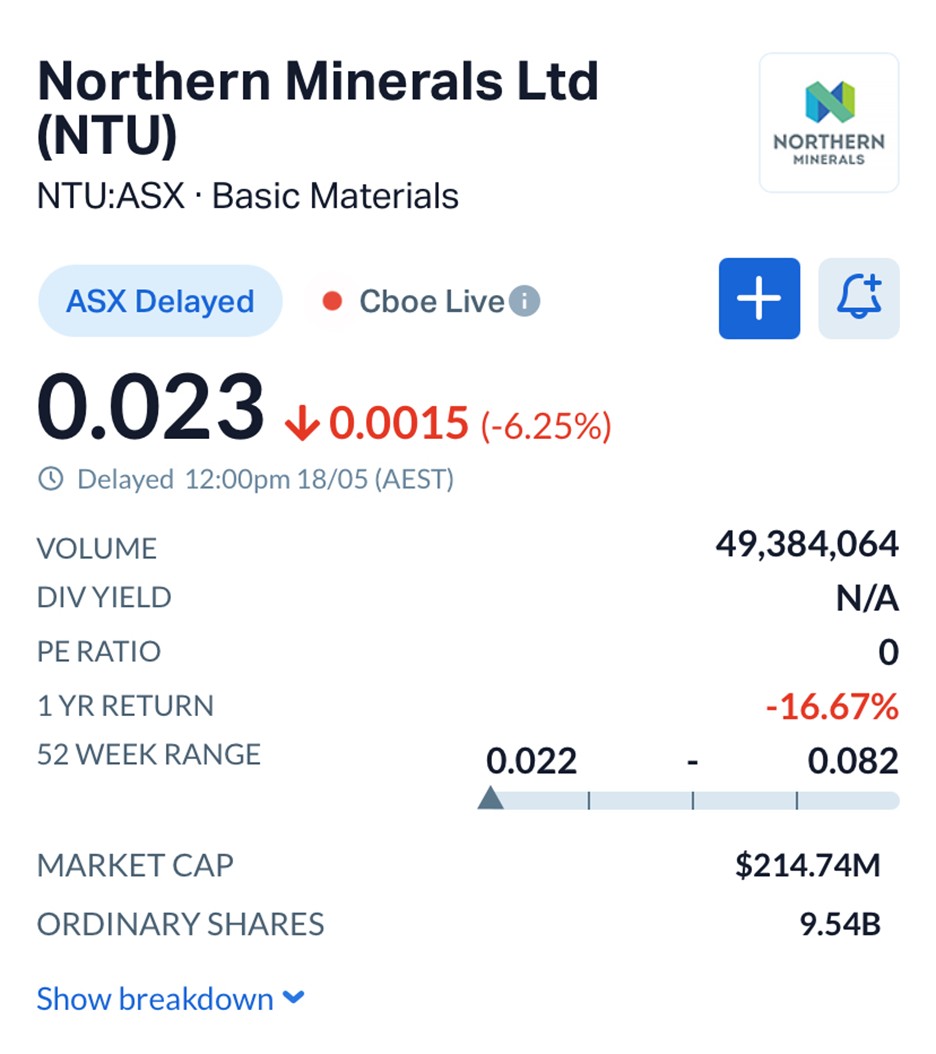
Source: MarketIndex
The move marks one of the strongest interventions yet by the Australian government into the critical minerals sector.
Northern Minerals controls the Browns Range project in Western Australia’s East Kimberley region, home to dysprosium and terbium deposits considered strategically significant for Western supply chains.
Those heavy rare earths sit at the centre of modern defense manufacturing. They are used in high-performance magnets found in missile guidance systems, industrial robotics, wind turbines and electric vehicle drivetrains.
The global refining market remains overwhelmingly concentrated in China, which controls close to 90 per cent of rare earth processing capacity, according to the International Energy Agency and US Geological Survey data.
Against that backdrop, governments across the US, Australia and Europe have increasingly treated critical mineral projects as strategic infrastructure rather than ordinary mining assets.
For Northern Minerals, the forced divestment creates near-term uncertainty around its register, but it also removes a major regulatory overhang that had lingered around the project for years.
The decision potentially clears the path for future financing support tied to Western-aligned supply chains, including export credit agencies and defense-linked commercial partnerships.
Across the market, Challenger Gold (ASX: CEL) delivered a very different kind of signal.
The company emerged from a trading halt after locking in an A$85 million institutional placement backed by existing cornerstone investors alongside two new global funds.
Shares rose 1.85 per cent to 13.8 cents in early afternoon trade.
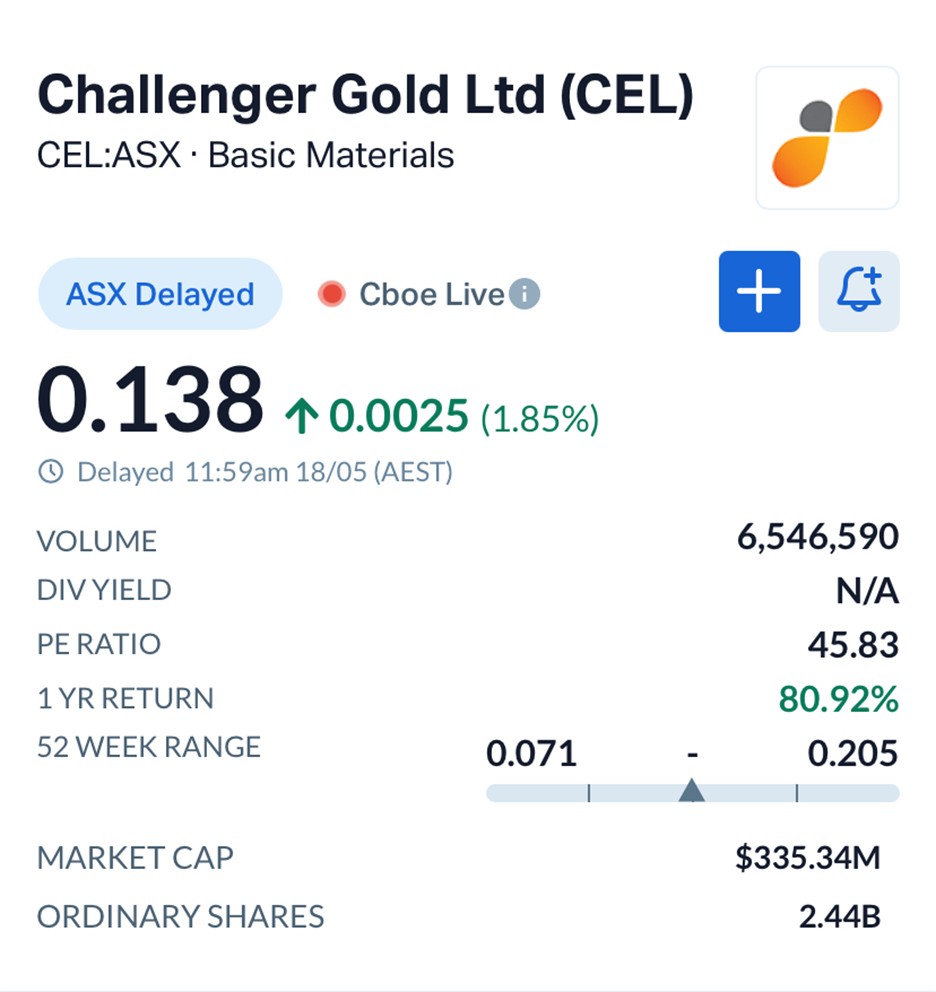
Source: MarketIndex
The raise comes as gold prices continue hovering near record levels, reshaping sentiment toward advanced development projects with defined pathways to production.
What caught the market’s attention was not just the size of the raise, but who arrived alongside it.
Mining executive Peter Marrone, former Yamana Gold chief and current Allied Gold CEO, anchored the deal with a A$10 million investment and will join Challenger Gold as Non-Executive Chairman-elect.
Former Yamana COO Yohann Bouchard has also joined as Chief Operating Officer.
Stay ahead of the market
The most important stories, delivered to your inbox. No noise, just what matters.
By subscribing, you agree to our Privacy Policy.
The appointments add heavyweight operational experience to the company’s Hualilan Gold Project in Argentina, which recently completed its Pre-Feasibility Study.
The fresh capital will fund advancement toward a Definitive Feasibility Study while also supporting a broader drilling campaign across the surrounding tenements.
The tone across the gold sector has shifted noticeably over the past 12 months.
As bullion prices pushed higher, the market began drawing a harder distinction between speculative explorers and companies carrying scale, funding access and operational depth.
That separation is becoming more visible across the ASX resource space more broadly.
Projects tied to strategic minerals are increasingly attracting geopolitical support, while development-stage assets with financing certainty continue pulling institutional capital away from early-stage exploration plays.
The modern mining cycle is starting to reward something beyond discovery alone.
Balance sheet strength, political alignment and execution capability are now carrying equal weight.
Northern Minerals secured the attention of Canberra.
Challenger Gold secured the attention of global mining capital.
Both landed at the centre of the same story.
What is your take on this story?
This is user sentiment & not financial advice.
Disclaimer - Skrill Network is designed solely for educational and informational use. The content on this website should not be considered as investment advice or a directive. Before making any investment choices, it is crucial to carry out your own research, taking into account your individual investment objectives and personal situation. If you're considering investment decisions influenced by the information on this website, you should either seek independent financial counsel from a qualified expert or independently verify and research the information.