

Why Vection (ASX: VR1) is Gaining Momentum: Inside the $1.1M Defense & AI Expansion

Team Skrill Network
Team Skrill Network comprises seasoned professionals from diverse fields including Finance, Mining, Technology, Investing, and Digital Strategy. They bring a deep knowledge and understanding of financial markets and behavioural patterns to every story, ensuring credibility and precision in every piece. Whether analysing emerging market trends or spotlighting small- and mid-cap growth companies across ASX, TSX, or NASDAQ, the team’s editorial approach blends data-driven insights with compelling storytelling. Their expertise enables them to process complex developments into content that resonates with both institutional investors and retail audiences. Backed by experience in content curation, SEO strategy, and investor-focused messaging, the team of writers at Skrill Network are committed to delivering stories that matter—authentic, relevant, and strategically aligned with the evolving landscape of global investing.
Read more
Key Highlights
- Vection secured $1.1 million in new contracts fully recognised in FY26
- Shares climbed 11.36% to $0.025 in Thursday trade
- Defense programme lifetime orders reached $30.6 million
- Dell-powered security projects continue generating repeat business
- AI contracts expanded across banking, consulting, manufacturing and government sectors
Vection Technologies (ASX: VR1) moved higher on Thursday after the enterprise AI and extended reality software group announced $1.1 million in fresh contracts tied to defence infrastructure and artificial intelligence deployments.
The stock rose 11.36% to $0.025 by mid-afternoon trade, with more than 14.56 million shares changing hands as the market responded to signs of accelerating commercial momentum.
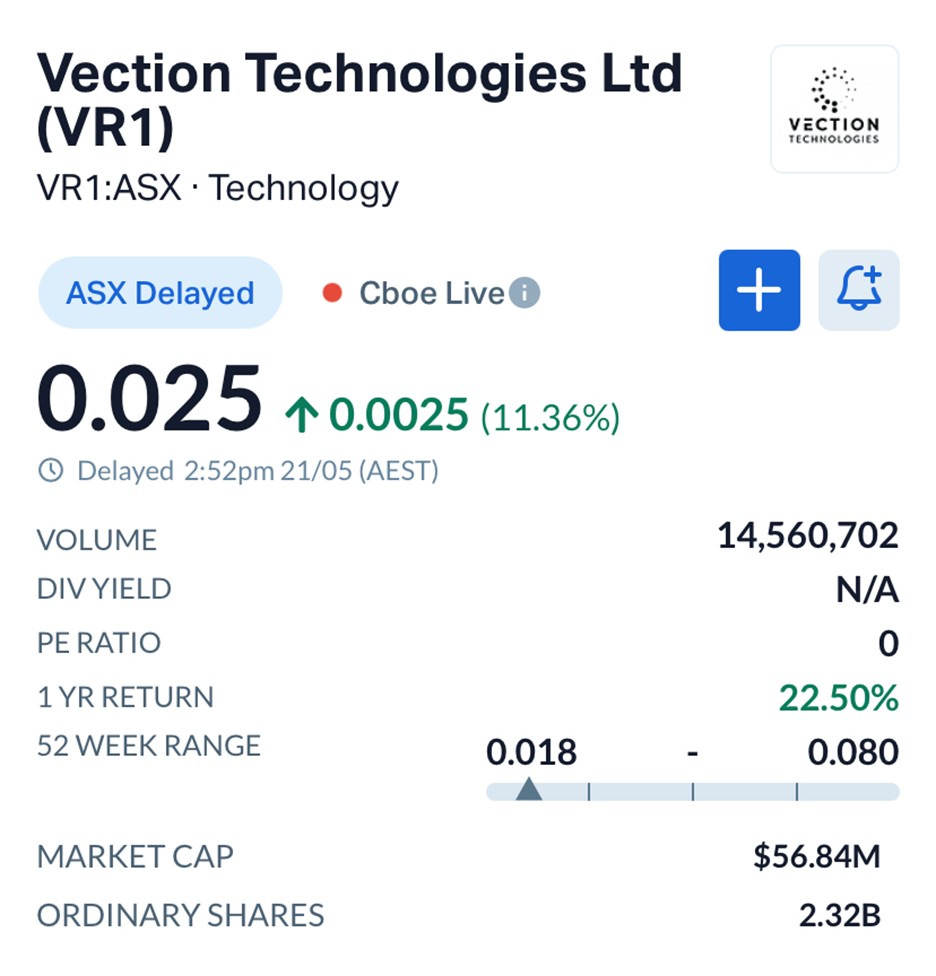
Market Snapshot
Source: MarketIndex
The contracts will be fully recognised in FY26 revenue, giving the update immediate financial weight rather than pushing earnings into future reporting periods.
For Vection, the announcement reflects something broader than a single order cycle. The company is steadily repositioning itself away from speculative XR experimentation and deeper into enterprise AI, defence software and mission-critical digital systems.
Defence contracts continue to expand
The larger portion of the update came from a $572,000 extension tied to an existing classified national security and law enforcement customer.
The project is being delivered alongside Dell Technologies AI infrastructure, extending a multi-year partnership that has increasingly become one of Vection’s strongest commercial channels.
The latest award pushed Vection’s cumulative defence programme orders to $30.6 million.
Management noted that profitability inside the defence segment is also improving as the company shifts toward more proprietary software deployments through platforms like FEDRA.
Vection Managing Director and Executive Chairman Gianmarco Biagi said repeat work from classified customers reflects long-term trust rather than short-term project wins.
“When a customer in a classified, mission-critical environment keeps extending, they are telling you something important: that your team delivers, your technology works, and the relationship is built on real trust,” Biagi said.
“We continue to see repeating order flow from this partnership.”
AI platform expands across multiple industries
The second half of the announcement focused on Vection’s Algho AI platform, which secured roughly $513,000 in new enterprise contracts across four separate sectors.
Rather than relying on one niche vertical, the company is now deploying AI systems across consulting groups, banks, manufacturers and public administration networks.
The largest order came from a corporate consultancy group using perpetual enterprise AI licences covering HR systems, supply chain operations, sales assistance and decision-making modules.
Banking clients adopted immersive AI ecosystems combining digital twins and conversational AI avatars for workforce training and innovation programmes.
Industrial manufacturing contracts included omnichannel customer service systems, live chat integration and automated lead generation tools.
Government contracts focused on multilingual AI tourism assistants integrated across websites, WhatsApp systems and physical outdoor kiosks.
The Dell relationship keeps growing
The latest defence extension follows a series of announcements over recent months that increasingly tie Vection’s growth story to Dell Technologies infrastructure.
Back in March, the company secured a separate $1.6 million recurring AI defence order powered through Dell systems.
The repeated collaboration matters because it gives Vection exposure to larger enterprise and government procurement ecosystems that smaller standalone software groups often struggle to access independently.
At the same time, Vection’s recently completed acquisition of DXLabs appears to be widening its commercial footprint.
The acquisition added approximately $3.5 million in revenue alongside $800,000 in EBIT and brought new enterprise and government relationships into the business.
Some of Thursday’s public administration wins appear directly linked to those expanded customer networks.
Financial footing continues improving
Part of the market’s positive response also reflects improving financial stability.
Stay ahead of the market
The most important stories, delivered to your inbox. No noise, just what matters.
By subscribing, you agree to our Privacy Policy.
Vection reported its third consecutive quarter of positive operating cash flow in its April quarterly update and ended the March quarter with $10.8 million in cash.
Debt was reduced by roughly $1.8 million over the same period.
That balance sheet improvement reduces pressure for emergency capital raisings while giving the company enough liquidity to continue delivering larger enterprise and defence projects.
The timing is important because AI-related infrastructure spending remains one of the fastest-growing themes globally.
Governments and corporations are increasing budgets around automation, simulation systems, predictive analytics and digital workforce tools as geopolitical tensions and cybersecurity concerns continue reshaping procurement priorities.
Biagi acknowledged that global instability is slowing some procurement timelines, but said the broader environment is also increasing demand for sovereign AI and defence-linked systems.
“The geopolitical environment is a real dynamic. It is extending timelines on some of our larger opportunities, but it is also making our capabilities more strategically valuable, not less,” he said.
Momentum shifts toward execution
For much of the past few years, Vection was largely viewed as a speculative XR company searching for commercial scale.
The recent sequence of defence contracts, recurring AI orders and improving cash flow suggests the market is beginning to reassess that positioning.
The company’s latest update points toward a more mature software model built around repeat enterprise deployments rather than isolated technology demonstrations.
Thursday’s share price reaction reflected that shift.
What is your take on this story?
This is user sentiment & not financial advice.
Disclaimer - Skrill Network is designed solely for educational and informational use. The content on this website should not be considered as investment advice or a directive. Before making any investment choices, it is crucial to carry out your own research, taking into account your individual investment objectives and personal situation. If you're considering investment decisions influenced by the information on this website, you should either seek independent financial counsel from a qualified expert or independently verify and research the information.