


Zip Co (ASX: ZIP) Rebuilds Momentum as US Growth Engine Drives $260M Earnings Outlook

Team Skrill Network
Team Skrill Network comprises seasoned professionals from diverse fields including Finance, Mining, Technology, Investing, and Digital Strategy. They bring a deep knowledge and understanding of financial markets and behavioural patterns to every story, ensuring credibility and precision in every piece. Whether analysing emerging market trends or spotlighting small- and mid-cap growth companies across ASX, TSX, or NASDAQ, the team’s editorial approach blends data-driven insights with compelling storytelling. Their expertise enables them to process complex developments into content that resonates with both institutional investors and retail audiences. Backed by experience in content curation, SEO strategy, and investor-focused messaging, the team of writers at Skrill Network are committed to delivering stories that matter—authentic, relevant, and strategically aligned with the evolving landscape of global investing.
Read more
Key Highlights
- Zip reaffirms FY26 cash EBTDA guidance of at least $260 million
- US transaction volumes surged more than 40% in April
- Bad debts remain tightly controlled below 1.75% of TTV in the US
- Company expands beyond BNPL with launch of subscription-based ZMobile service
Zip Co (ASX: ZIP) is beginning to look like one of the more unlikely comeback stories on the Australian share market.
Just two years ago, the buy now, pay later pioneer was battling rising funding costs, investor skepticism and fears the entire BNPL sector had become a casualty of higher interest rates.
Now, the company is reporting accelerating US growth, improving margins and tighter credit performance as it repositions itself from a high-growth fintech experiment into a more disciplined financial platform.
Market Snapshot
Shares in Zip Co (ASX: ZIP) climbed 3.37% to $2.605 on Thursday after the company used its Macquarie Group Conference presentation to reaffirm FY26 cash EBTDA guidance of at least $260 million.
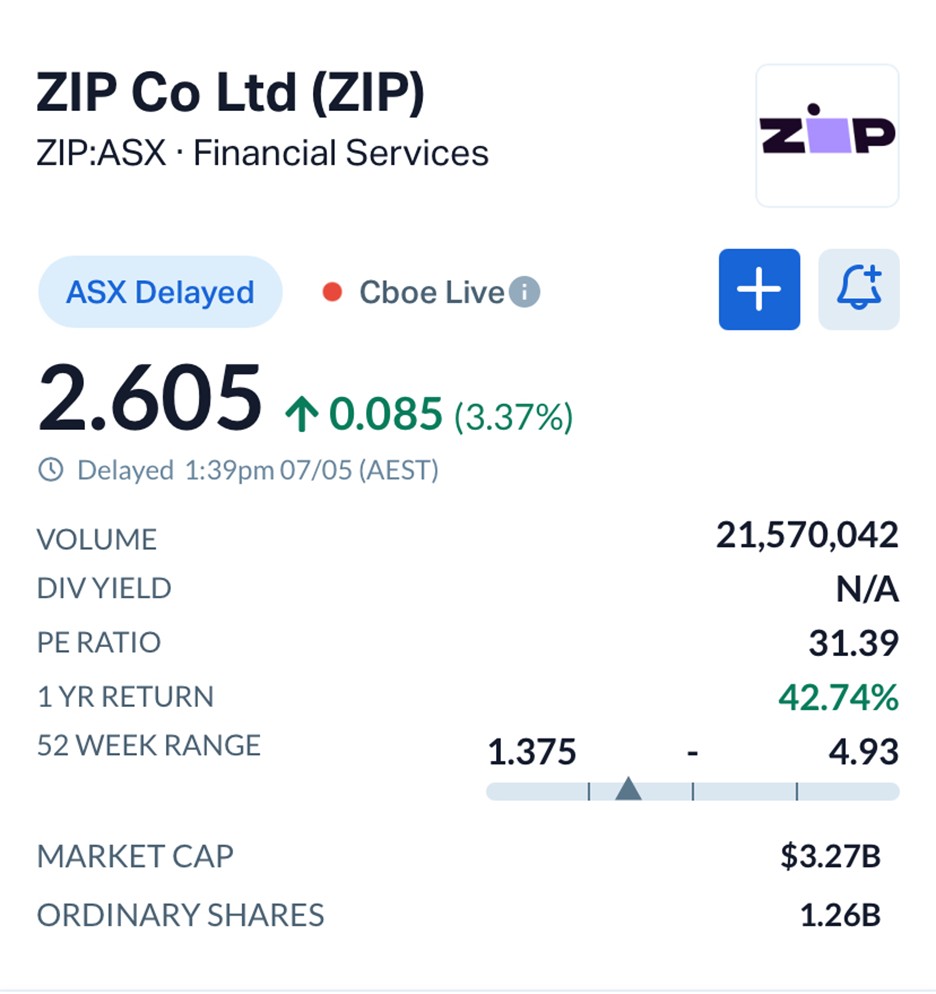
Source: MarketIndex
The update reinforced growing confidence that Zip’s restructuring strategy is beginning to pay off.
The US becomes the growth machine
The biggest driver behind the latest optimism continues to be the United States.
Zip reported that US total transaction volume growth exceeded 40% in April on a US dollar basis, highlighting strong consumer activity in what remains the world’s largest buy now, pay later market.
For years, many investors questioned whether Australian fintech companies could compete effectively in the US payments landscape against giants such as Affirm, PayPal and Klarna.
Zip now appears to be carving out a profitable niche.
The company currently serves 6.5 million active customers globally, including 4.6 million in the US and 1.9 million across Australia and New Zealand.
Importantly, management said the business is no longer pursuing growth at any cost.
Instead, the focus has shifted toward profitable scale and tighter credit controls.
That shift was visible in the latest bad debt numbers.
Zip expects US net bad debts to remain below 1.75% of total transaction volume during the fourth quarter of FY26, comfortably inside management’s target range of 1.5% to 2%.
In the BNPL sector, where concerns around consumer defaults have weighed heavily on valuations in recent years, that metric matters almost as much as revenue growth itself.
From “risky lender” to disciplined operator
The broader significance of Thursday’s update lies in how dramatically Zip’s narrative has changed since the fintech selloff of 2022 and 2023.
At the height of the BNPL boom, markets rewarded customer growth above almost everything else.
When interest rates surged globally, many fintech companies found themselves exposed to rising funding costs, weakening consumer conditions and growing regulatory scrutiny.
Zip responded by aggressively cutting costs, exiting several international markets and narrowing its strategic focus.
The latest numbers suggest that reset may finally be bearing fruit.
Group cash EBTDA rose 41.5% year-on-year to $65.1 million during the third quarter, while total income climbed 20.2% to $335.2 million.
The company also reaffirmed group operating margin guidance above 18%.
For a sector once criticized for prioritizing scale over sustainability, the update marked another step in Zip’s attempt to reposition itself as a mature financial technology business rather than a speculative growth stock.
AI underwriting and the “underestimated American”
Part of Zip’s US strategy now revolves around serving customer segments traditional lenders often avoid.
The company said it is using AI-driven underwriting systems powered by roughly 1.4 billion data points to assess borrowers outside conventional credit scoring models.
Chief Executive Officer Cynthia Scott described the US business as a strong early-stage opportunity supported by disciplined lending practices.
“High-growth US business executing strongly in an attractive early-stage market,” Scott said.
“We have a proven ability to profitably underwrite these customers.”
Scott added that the company’s scalable platform was generating operating leverage through continued investment in artificial intelligence and automation.
The strategy reflects a broader shift occurring across global fintech markets.
While traditional banks continue relying heavily on historical credit scoring systems, newer digital lenders are increasingly turning toward behavioural data, transaction patterns and real-time analytics to assess risk.
Stay ahead of the market
The most important stories, delivered to your inbox. No noise, just what matters.
By subscribing, you agree to our Privacy Policy.
BNPL moves beyond retail spending
Another notable trend emerging from Zip’s update is the evolution of how consumers are using buy now, pay later products.
The sector was initially associated heavily with fashion and discretionary shopping.
That appears to be changing.
Zip said some of its fastest-growing spending categories now include automotive services, transport, utilities, insurance and fuel.
The shift suggests BNPL products are becoming embedded into everyday household budgeting rather than simply acting as retail checkout tools.
In Australia, the company is also pushing deeper into subscription-style financial services through the launch of ZMobile, a telecommunications offering powered by TPG Telecom.
The move gives Zip exposure to recurring subscription revenue while increasing customer retention within its ecosystem.
Scott described the Australian and New Zealand operations as a profitable market-leading business serving roughly 10% of Australia’s adult population.
Fintech sentiment slowly turns
The broader fintech sector has endured a difficult few years globally as higher rates forced markets to reassess risk and profitability.
Many companies once valued primarily on future growth projections have since faced pressure to demonstrate cash flow discipline and stronger balance sheets.
Zip’s latest trading update suggests the company may now be entering a different phase.
The business is still growing strongly, particularly in the US, but it is doing so with tighter credit controls, expanding margins and clearer earnings visibility.
That combination is increasingly rare across consumer fintech.
For markets that once viewed BNPL as a passing pandemic-era trend, Zip Co’s latest update suggests the sector may instead be evolving into a more established part of modern consumer finance.
What is your take on this story?
This is user sentiment & not financial advice.
Disclaimer - Skrill Network is designed solely for educational and informational use. The content on this website should not be considered as investment advice or a directive. Before making any investment choices, it is crucial to carry out your own research, taking into account your individual investment objectives and personal situation. If you're considering investment decisions influenced by the information on this website, you should either seek independent financial counsel from a qualified expert or independently verify and research the information.