


Zip Co (ASX: ZIP) Shares Plunge 38% Despite Record Cash Earnings and Upgraded Guidance

Team Skrill Network
Team Skrill Network comprises seasoned professionals from diverse fields including Finance, Mining, Technology, Investing, and Digital Strategy. They bring a deep knowledge and understanding of financial markets and behavioural patterns to every story, ensuring credibility and precision in every piece. Whether analysing emerging market trends or spotlighting small- and mid-cap growth companies across ASX, TSX, or NASDAQ, the team’s editorial approach blends data-driven insights with compelling storytelling. Their expertise enables them to process complex developments into content that resonates with both institutional investors and retail audiences. Backed by experience in content curation, SEO strategy, and investor-focused messaging, the team of writers at Skrill Network are committed to delivering stories that matter—authentic, relevant, and strategically aligned with the evolving landscape of global investing.
Read more
Key Highlights
- Share price tumbles 38% to $1.74 on heavy volume
- Cash EBTDA jumps 85.6% to $124.3m in 1H26
- US now accounts for 75% of total transaction volume
- Operating margin expands to 18.7%, guidance upgraded
Zip Co’s results read like a turnaround success story. The share price reaction told a very different story.
The buy now, pay later provider delivered record first half cash earnings, upgraded its full year guidance and expanded margins significantly. Yet by early afternoon trade, Zip shares were down more than 37.59% to $1.76, wiping billions from its market value in one of the most dramatic sell offs of reporting season.
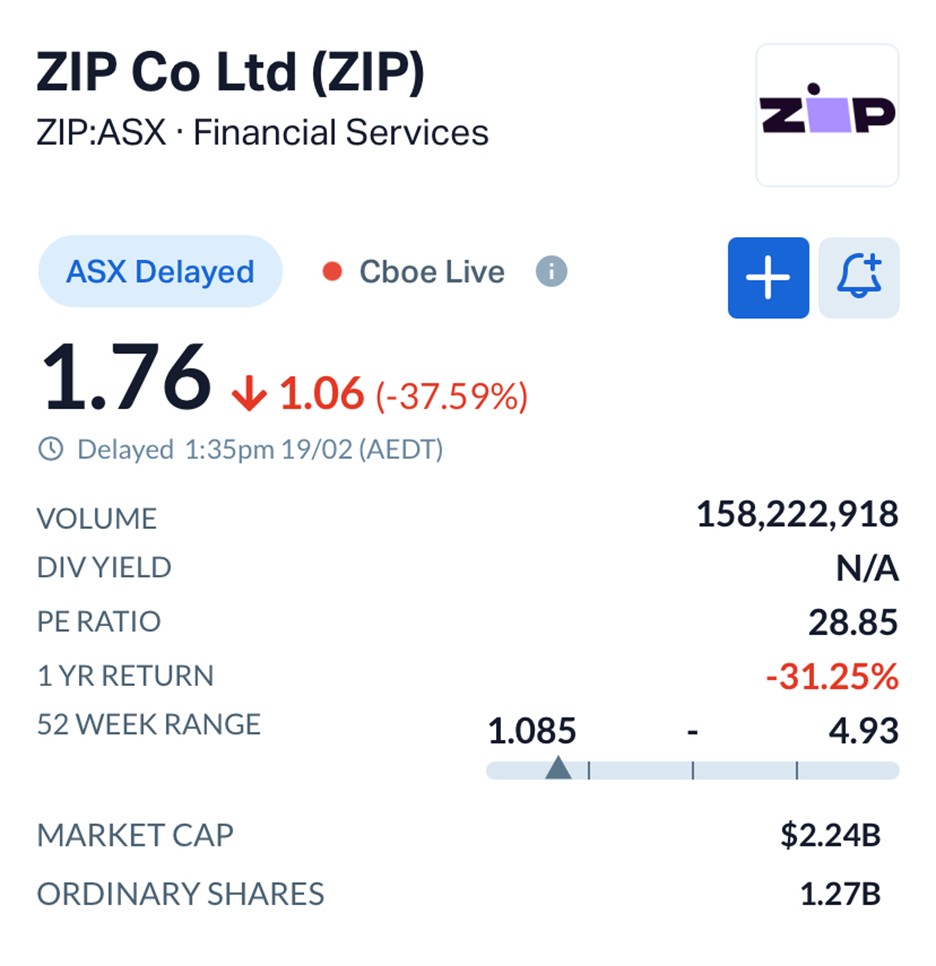
Market Snapshot
ZIP Stock Price | Source: MarketIndex
The contrast is striking.
According to Zip’s 1H FY26 results released today , the group posted record cash EBTDA of $124.3 million, up 85.6% year on year. Operating margin expanded to 18.7% from 13.0% a year earlier. Total transaction volume rose 34.1% to $8.4 billion, while total income increased 29.2% to $664 million.
Chief Executive Officer Cynthia Scott described the half as one where Zip “continues to increase profitability at scale, driving cash earnings growth of 85.6% and significant operating margin expansion during the half.”
The company also upgraded FY26 guidance for operating margin to above 18% and lifted cash EBTDA as a percentage of TTV to greater than 1.4%. On paper, this is the kind of result growth stocks aspire to.
So why the sell off?
The answer lies beneath the headline numbers.
While revenue margin slipped slightly to 7.9% from 8.2%, the shift in business mix is more telling. The United States now accounts for 75% of group TTV . The US business delivered TTV growth of 44.2% in USD terms, but the American market carries structurally different unit economics compared to ANZ.
Investors appear concerned that Zip is becoming increasingly exposed to the lower margin and more competitive US buy now, pay later landscape. Revenue margin compression, even modest, tends to amplify fears about sustainability of earnings.
Net bad debts also ticked up slightly to 1.73% of TTV from 1.56% a year earlier. While management says this is in line with strategic settings, the market is hypersensitive to credit risk in a higher rate environment.
There is also the psychology of expectations.
Zip has long been a high beta retail favourite. Its shares traded as high as $4.93 over the past year and have experienced multiple boom and bust cycles since the pandemic BNPL surge. When expectations build into reporting season, even strong numbers can disappoint if growth is not accelerating fast enough.
The company’s cash conversion remains robust, with a cash net transaction margin of 3.8%, unchanged year on year . It also completed a $100 million on market buyback in December, repurchasing shares at an average price of $2.86 . Today’s share price sits well below that level.
Stay ahead of the market
The most important stories, delivered to your inbox. No noise, just what matters.
By subscribing, you agree to our Privacy Policy.
Strategically, Zip is doubling down on the US. Scott confirmed she intends to relocate to the United States in the second half of 2026, aligning leadership with the company’s primary earnings driver . The group is also considering a potential dual listing in the US, subject to market conditions.
In the US, Zip expanded its Pay in 2 product nationwide in February and continues to integrate deeper into platforms such as Stripe and Google Pay . Management highlighted strong holiday trading and record transaction days in the December quarter.
Yet the broader buy now, pay later sector has matured. After years of rapid expansion, the market is now focused on durable margins, credit quality and cash generation rather than raw volume growth. Zip is delivering profitability, but the shift toward the US market introduces new variables that investors are still pricing in.
By early afternoon, more than 156 million shares had changed hands, reflecting intense selling pressure.
For now, Zip’s results demonstrate a company that has repaired its balance sheet, expanded margins and upgraded guidance. The market’s verdict suggests that confidence in the sustainability of those gains remains fragile.
In high growth fintech, perception often moves faster than fundamentals. Today was a reminder of that.
What is your take on this story?
This is user sentiment & not financial advice.
Disclaimer - Skrill Network is designed solely for educational and informational use. The content on this website should not be considered as investment advice or a directive. Before making any investment choices, it is crucial to carry out your own research, taking into account your individual investment objectives and personal situation. If you're considering investment decisions influenced by the information on this website, you should either seek independent financial counsel from a qualified expert or independently verify and research the information.