


Nanoveu (ASX: NVU) Delivers 27.8% Drone Efficiency Breakthrough That Could Reshape Commercial Aviation

Key Highlights
• Nanoveu’s EMASS subsidiary achieves up to 27.8% improvement in drone energy efficiency during live flight testing
• ECS-DoT Edge AI chip consumes less than 10mW while extending operational range
• Technology requires no battery, motor or airframe modifications
• Targets high-growth sectors including delivery drones, defence, agriculture and surveillance
• Latest breakthrough follows Nanoveu’s acquisition of Spinoff Robotics in May
For years, the biggest challenge facing the drone industry has not been intelligence, sensors, or software. It has been endurance.
Whether delivering parcels, monitoring crops, patrolling borders, or inspecting infrastructure, drones are ultimately limited by how long they can stay in the air before needing a recharge.
Nanoveu (ASX: NVU) believes it may have found a solution, and importantly, one that does not require bigger batteries or lighter aircraft.
The technology company announced that its subsidiary EMASS has successfully completed live flight testing of its ECS-DoT Edge AI chip, demonstrating energy efficiency improvements of up to 27.8% under real-world operating conditions.
The market responded positively, with Nanoveu shares trading at $0.059 on Monday morning, valuing the company at approximately $63.7 million.
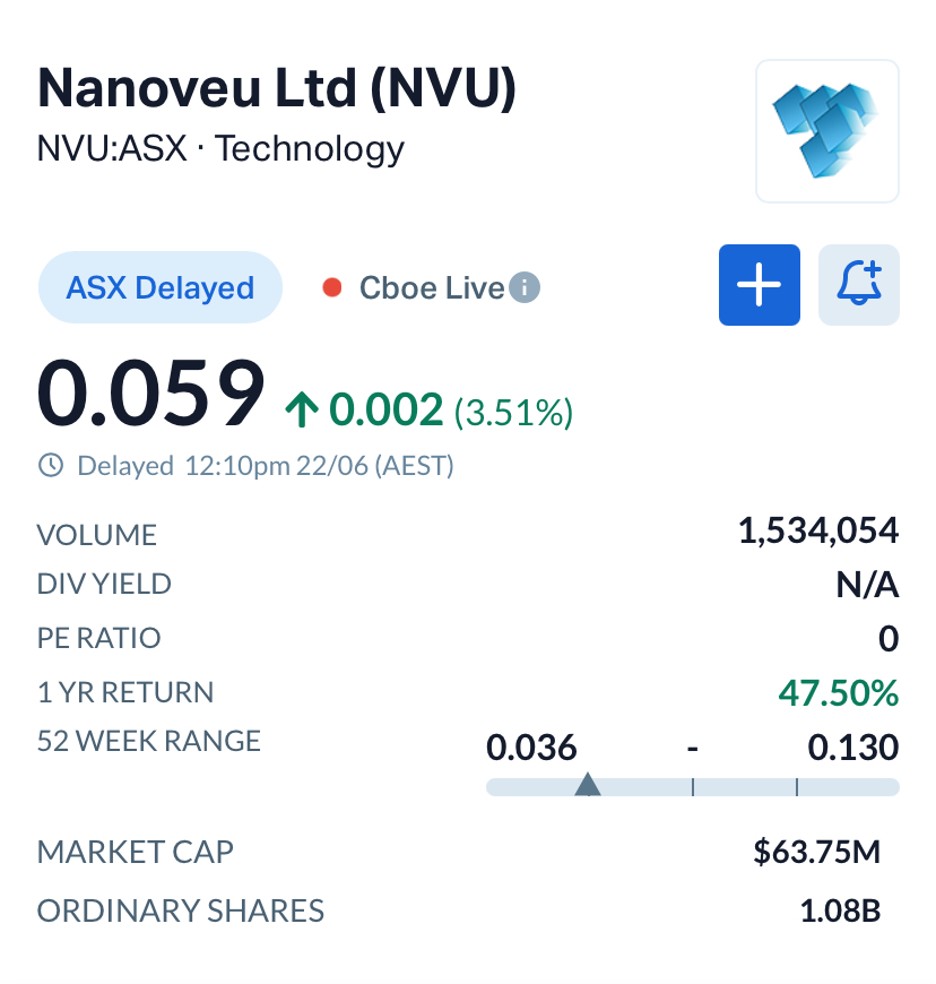
Source: MarketIndex
Turning software into extra flight time
The breakthrough centres on how drones manage movement rather than how they generate power.
Testing showed the ECS-DoT chip delivered a 27.8% improvement in cruise efficiency at flight speeds of 4 metres per second and 26.7% at 6 metres per second. Across all test scenarios, efficiency gains averaged 27.2%.
The most significant improvements occurred during turns and short flight segments, where conventional autopilot systems often waste energy through unnecessary speed adjustments and flight corrections.
In some short-route tests, efficiency gains reached as high as 39.4%.
What makes the result particularly notable is the tiny amount of power consumed by the AI processor itself.
According to the company, the ECS-DoT chip uses less than 10 milliwatts of total system power, with the core AI inference engine operating below 1 milliwatt. That represents roughly 0.0002% of a drone’s overall cruise energy budget.
Dr Mohamed M. Sabry Aly, Director and Founder of EMASS, said the results validate years of development work.
“Taking ECS-DoT from simulation into live flight and seeing the data hold up is a significant validation. What these results demonstrate is that meaningful endurance gains do not require hardware changes. They require better control.”
“These are early-stage results and we expect them to grow as the models mature and we expand across more platforms and speeds.”
Why endurance matters
The commercial drone market has expanded rapidly over the past decade, but battery limitations continue to constrain large-scale deployment.
According to industry estimates, commercial drone operators lose significant productivity through frequent battery changes, reduced coverage areas and operational downtime.
Nanoveu’s technology specifically targets environments where drones follow repetitive flight paths, including last-mile delivery routes, precision agriculture programs, perimeter security patrols and urban surveillance missions.
Instead of increasing battery size, the company’s software optimises flight decisions in real time, reducing wasted energy while maintaining performance.
Dr Tan Chee How, Chief Executive Officer of Spinoff Robotics and an aerial robotics specialist, believes the implications could be significant.
“Flight endurance has been the binding constraint on commercial drone adoption for years.”
“The approaches that have moved the needle so far have all required hardware changes: bigger batteries, lighter frames, more efficient motors. What ECS-DoT demonstrates here is that meaningful gains are achievable through software and AI control alone, at a negligible power cost using ECS-DoT. That changes the economics of the problem entirely.”
Building a broader drone ecosystem
The announcement represents the latest step in a rapid transformation for Nanoveu.
In May, the company completed its acquisition of Spinoff Robotics, significantly expanding its capabilities in autonomous systems and drone technologies.
Stay ahead of the market
The most important stories, delivered to your inbox. No noise, just what matters.
By subscribing, you agree to our Privacy Policy.
Just last week, EMASS announced another milestone after achieving microphone-free keyword recognition at ultra-low power consumption levels below one milliwatt.
Together, these developments suggest Nanoveu is evolving beyond its traditional technology roots and positioning itself within the broader artificial intelligence, robotics and autonomous systems markets.
The company is also progressing intellectual property filings covering its AI flight optimisation framework and drone integration architecture, laying the groundwork for potential licensing opportunities.
Opportunity meets execution risk
Unlike many hardware-focused drone innovations, ECS-DoT does not require redesigning aircraft, changing batteries or modifying propulsion systems. That could significantly reduce adoption barriers across commercial fleets.
The company is already working with an unnamed US-based drone partner to integrate the technology into proprietary flight control systems.
However, challenges remain.
The testing was conducted on a 2.8-kilogram drone platform, meaning larger industrial and military applications still require validation. Commercial adoption will also depend on lengthy integration cycles with drone manufacturers and enterprise operators.
The bigger picture
As artificial intelligence increasingly moves from data centres to edge devices, energy efficiency is becoming just as important as processing power.
Nanoveu’s latest results suggest there may be substantial gains available through smarter software rather than larger batteries.
If future testing confirms similar improvements across larger platforms, the company could find itself addressing one of the most persistent challenges in the global drone industry.
For now, the live flight data provides an early indication that software-driven endurance gains may become an increasingly important part of the next chapter in autonomous aviation.
Source: Nanoveu ASX announcement (22 June 2026), EMASS live-flight trial data, company presentations and management commentary.
What is your take on this story?
Disclaimer - Skrill Network is designed solely for educational and informational use. The content on this website should not be considered as investment advice or a directive. Before making any investment choices, it is crucial to carry out your own research, taking into account your individual investment objectives and personal situation. If you're considering investment decisions influenced by the information on this website, you should either seek independent financial counsel from a qualified expert or independently verify and research the information.