


Proteomics International (ASX: PIQ) Wins Key US Patent as Endometriosis Blood Test Moves Closer to Commercialisation

Neha Dev
Neha Dev is a finance writer and doctoral researcher in Finance at Maharaja Agrasen University, Baddi, where she also taught as an Assistant Professor for five years. Blending rigorous academic expertise with international industry experience, her background includes managing regional market strategies in South East Asia for Scholastic International and corporate finance training for Procter & Gamble. She holds advanced post-graduate qualifications in International Business, Personnel Management, and Labour Law, bringing a comprehensive, macro-level perspective to financial journalism.
Read more
Team Skrill Network
Team Skrill Network comprises seasoned professionals from diverse fields including Finance, Mining, Technology, Investing, and Digital Strategy. They bring a deep knowledge and understanding of financial markets and behavioural patterns to every story, ensuring credibility and precision in every piece. Whether analysing emerging market trends or spotlighting small- and mid-cap growth companies across ASX, TSX, or NASDAQ, the team’s editorial approach blends data-driven insights with compelling storytelling. Their expertise enables them to process complex developments into content that resonates with both institutional investors and retail audiences. Backed by experience in content curation, SEO strategy, and investor-focused messaging, the team of writers at Skrill Network are committed to delivering stories that matter—authentic, relevant, and strategically aligned with the evolving landscape of global investing.
Read more
Key Highlights
- Proteomics International secures a US patent for its PromarkerEndo blood test, with protection extending to March 2041.
- Patent covers diagnosing endometriosis using protein biomarkers and guiding treatment decisions.
- The US approval strengthens licensing prospects in the world’s largest healthcare market.
- PIQ shares climbed 19.36% to A$0.185, with trading volume topping 1.23 million shares.
For millions of women living with endometriosis, getting a diagnosis can take years. For Proteomics International (ASX: PIQ), the latest milestone is aimed at shortening that journey while strengthening the commercial foundations of one of its flagship technologies.
The Perth-based diagnostics company has secured a US patent for PromarkerEndo, its proprietary blood test designed to help diagnose endometriosis. The patent is expected to remain in force until March 2041, subject to standard maintenance requirements, giving the company long-term protection in the world’s largest healthcare market.
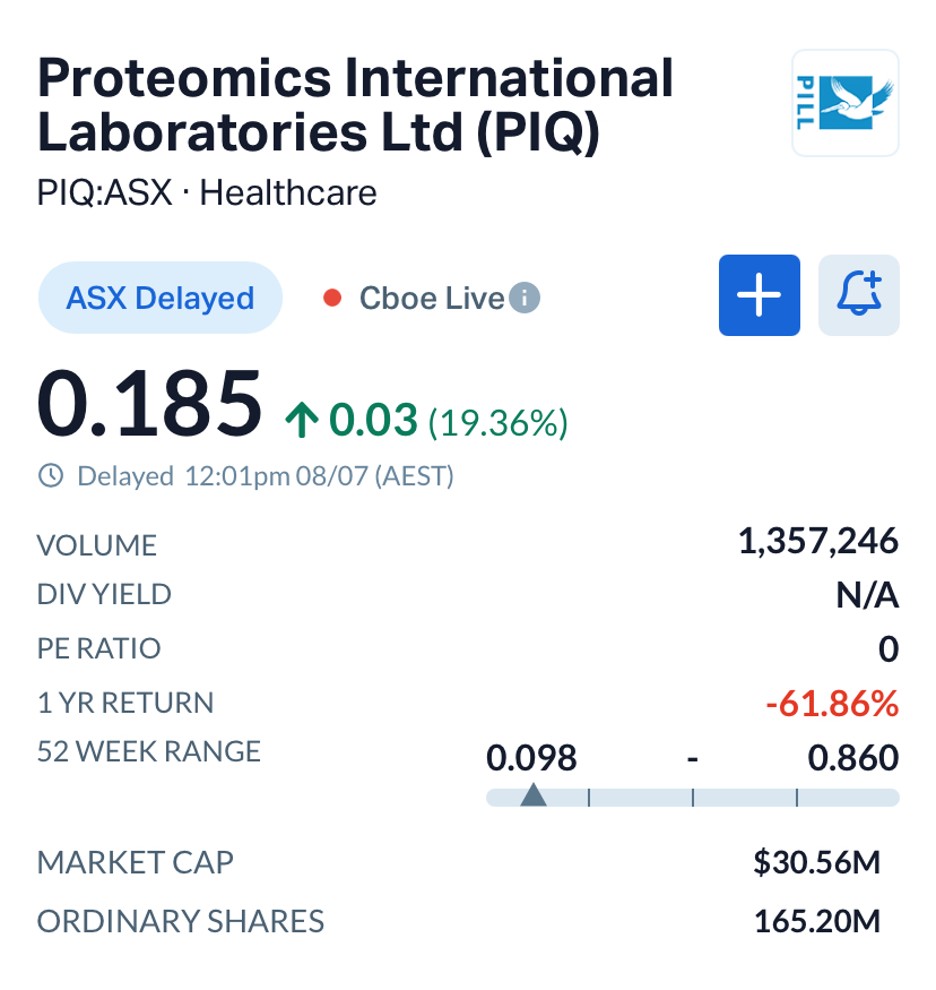
The market welcomed the news. Shares in Proteomics International rose 19.36% to A$0.185 in morning trade, lifting the company’s market capitalisation to around A$30.56 million.
Market Snapshot
Source: MarketIndex
Unlike many biotechnology announcements centred on laboratory research, a granted patent provides legally enforceable protection over intellectual property. In this case, it covers methods of diagnosing endometriosis using protein biomarkers measured through a blood test, along with using those results to help guide treatment decisions.
That matters because intellectual property is often one of the most valuable assets for emerging healthcare companies. Strong patent protection can improve licensing discussions, support future commercial partnerships and provide greater confidence as products move through regulatory and reimbursement pathways.
Today’s update also reflects a broader shift taking place across healthcare. Hospitals and clinicians are increasingly looking for non-invasive diagnostic tools that can detect disease earlier while reducing the need for costly or invasive procedures.
Endometriosis remains one of the most underdiagnosed women’s health conditions globally. It affects around one in nine women, according to Australian health data, and diagnosis often takes around seven years, with many patients requiring laparoscopic surgery before the condition is confirmed. A reliable blood test could simplify that process and help patients begin treatment sooner. Source: Australian Institute of Health and Welfare; World Health Organization.
The United States represents the largest diagnostics market globally, making patent protection there particularly valuable. The latest approval builds on earlier progress after Proteomics International secured patent protection for PromarkerEndo in Japan, while applications continue across Australia, Europe, Canada, China, India, Singapore and South Korea.
The company has also previously reported clinical data showing strong diagnostic accuracy, including in the early stages of endometriosis. As scientific validation continues to build, attention is gradually shifting towards commercial execution.
Chief Executive Officer and Managing Director Dr David Morris said securing protection in the United States marked an important step in the company’s global strategy.
“The grant of this patent by the USPTO is a major achievement and an important validation of the novelty and commercial potential of PromarkerEndo.”
He added:
“The United States is the world’s largest healthcare market and securing patent protection in this jurisdiction is a critical step in our global commercialisation strategy. This milestone significantly strengthens our position for future partnerships, licensing discussions, and regulatory reimbursement advancement.”
Stay ahead of the market
The most important stories, delivered to your inbox. No noise, just what matters.
By subscribing, you agree to our Privacy Policy.
Industry observers have increasingly highlighted blood-based diagnostics as one of the fastest-growing segments in precision medicine, driven by advances in biomarker research and growing demand for earlier disease detection. Pharmaceutical companies and diagnostic groups have also placed greater emphasis on protecting not only the underlying science but the commercial intellectual property that supports future market exclusivity. Source: Grand View Research; MarketsandMarkets Precision Medicine Reports.
The patent does not eliminate the work still ahead. PromarkerEndo must continue progressing through regulatory, reimbursement and commercialisation milestones before widespread adoption becomes possible. Like many emerging healthcare companies, Proteomics International also faces the execution challenges associated with bringing a novel diagnostic into routine clinical practice.
Even after Wednesday’s rally, the shares remain down 61.86% over the past year, highlighting the volatility often seen across the small-cap biotechnology sector.
Still, today’s company update shifts the conversation. Rather than asking whether the underlying science can be protected, attention is now turning to how quickly Proteomics International can translate that protected intellectual property into commercial agreements, regulatory approvals and, ultimately, routine use in clinics.
For a company moving from research towards commercial diagnostics, that may prove to be the more important test.
Sources: Proteomics International ASX Announcement (8 July 2026); Australian Institute of Health and Welfare; World Health Organization; Grand View Research; MarketsandMarkets.
What is your take on this story?
This is user sentiment & not financial advice.
Disclaimer - Skrill Network is designed solely for educational and informational use. The content on this website should not be considered as investment advice or a directive. Before making any investment choices, it is crucial to carry out your own research, taking into account your individual investment objectives and personal situation. If you're considering investment decisions influenced by the information on this website, you should either seek independent financial counsel from a qualified expert or independently verify and research the information.