

Iondrive Limited (ASX:ION) Delivers Rare Earth Recycling Breakthrough as Dysprosium Recovery Surges to 93.5%

Team Skrill Network
Team Skrill Network comprises seasoned professionals from diverse fields including Finance, Mining, Technology, Investing, and Digital Strategy. They bring a deep knowledge and understanding of financial markets and behavioural patterns to every story, ensuring credibility and precision in every piece. Whether analysing emerging market trends or spotlighting small- and mid-cap growth companies across ASX, TSX, or NASDAQ, the team’s editorial approach blends data-driven insights with compelling storytelling. Their expertise enables them to process complex developments into content that resonates with both institutional investors and retail audiences. Backed by experience in content curation, SEO strategy, and investor-focused messaging, the team of writers at Skrill Network are committed to delivering stories that matter—authentic, relevant, and strategically aligned with the evolving landscape of global investing.
Read more
Key Highlights
• Iondrive (ASX:ION) achieves 93.5% Dysprosium recovery from commercial U.S. e-waste feedstock
• Recovery rate far exceeds the 32.5% assumption used in the company’s 2025 economic study
• Independent testing also delivers 96.5% recovery for Neodymium and Praseodymium
• New process removes 99.9% of iron impurities without losing target rare earths
• Shares rise 10.53% as market responds to the technology milestone
The global race to secure rare earth supply chains is no longer focused solely on mining.
As governments and manufacturers search for alternatives to traditional sources of critical minerals, recycling technologies are increasingly emerging as a second frontier in the battle for strategic resources.
Market Snapshot
That backdrop makes the latest update from Iondrive Limited (ASX:ION) particularly noteworthy.
The company has announced independently validated results from its proprietary IONSolv™ extraction platform, revealing a dramatic improvement in the recovery of Dysprosium, one of the world’s most valuable and strategically important heavy rare earth elements.
The testing was conducted in the United States by Kingston Process Metallurgy under the oversight of ProProcess Engineering using commercial e-waste supplied by Colt Recycling LLC.
The standout result was a 93.5% Dysprosium recovery rate from a single-pass leach process.
That figure is almost three times higher than the 32.5% recovery assumption used in Iondrive’s November 2025 Techno-Economic Analysis.
For a company developing rare earth recycling technology, the significance extends beyond a simple laboratory result.
Dysprosium is a critical ingredient used in high-performance permanent magnets found in electric vehicles, wind turbines, advanced electronics and defence systems. It is also one of the most supply-constrained rare earth elements globally, with China continuing to dominate much of the mining and processing market.
Industry analysts have repeatedly highlighted Dysprosium as one of the most strategically sensitive minerals required for the global energy transition.
Iondrive’s latest results suggest the company may have significantly underestimated the potential economics of its recycling platform.
The validation program also delivered strong outcomes across other key magnet materials.
Neodymium recovery reached 96.5%, exceeding the company’s previous assumption of 95.5%, while Praseodymium recovery also climbed to 96.5%, outperforming the original 92% estimate.
Perhaps equally important was the process’s ability to handle lower-quality commercial feedstock.
According to the company, the e-waste tested contained higher iron concentrations and lower rare earth grades than those assumed in earlier economic models. Despite those challenges, the IONSolv™ process maintained strong recovery performance.
A newly introduced solvent extraction stage also achieved a 99.9% iron rejection rate, eliminating a major obstacle often associated with rare earth recycling.
The market responded positively to the announcement.
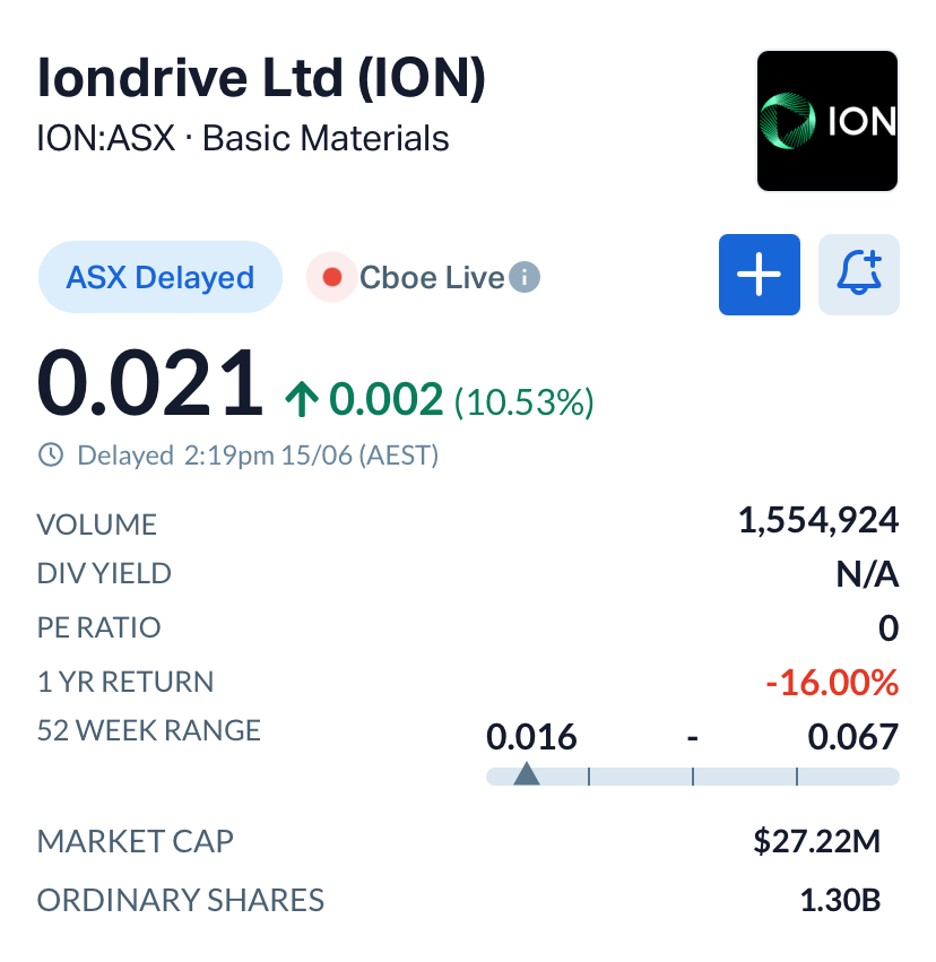
Iondrive shares were trading 10.53% higher at $0.021 by mid-afternoon on Monday, with more than 1.5 million shares changing hands. The company currently carries a market capitalisation of approximately $27.2 million.
While the share price remains well below its 52-week high of $0.067, the latest results arrive at a time when rare earth supply security has become a growing strategic priority for Western economies.
Source: MarketIndex
The United States, in particular, has intensified efforts to establish domestic supply chains for critical minerals used in defence technologies, electric vehicles and renewable energy infrastructure.
That trend could create opportunities for recycling companies capable of recovering valuable materials from existing waste streams rather than relying solely on new mine development.
Stay ahead of the market
The most important stories, delivered to your inbox. No noise, just what matters.
By subscribing, you agree to our Privacy Policy.
The breakthrough may also reshape the economics of Iondrive’s proposed commercial rollout.
Its 2025 Techno-Economic Analysis examined a modular 2,000-tonne-per-year processing plant requiring an estimated capital investment of US$4.6 million. Based on the assumptions available at the time, the project generated an estimated net present value of US$7 million, a 46% internal rate of return and a 2.6-year payback period.
Those calculations were built around a Dysprosium recovery rate of just 32.5%.
With new validation results showing recoveries of 93.5%, management is now preparing to update the economic model through a formal Pre-Feasibility Study.
Managing Director Lewis Utting said the results represent a meaningful step forward for the platform.
“Dysprosium is among the most strategically constrained and highest-value elements in the magnet bundle, and recovering targets like this at above 93%, well above the TEA assumption, is a genuine step-change for the platform. Our April update confirmed strong Neodymium and Praseodymium extraction. These latest results extend that strength into the HRE elements as well, alongside high iron rejection.”
“We look forward to updating the TEA through the next phase into a PFS. Demonstrating use cases that are both technically effective and commercially viable is central to our commercialisation strategy and our alignment with US supply-chain resilience priorities.”
While commercial feedstock agreements remain at an early stage and the results are yet to undergo full mass-balance verification, the latest validation marks a significant technical milestone.
In a sector where supply security, recycling and critical minerals increasingly intersect, Iondrive’s progress suggests the future of rare earth production may not only come from the ground, but also from recovering value hidden inside yesterday’s electronics.
What is your take on this story?
This is user sentiment & not financial advice.
Disclaimer - Skrill Network is designed solely for educational and informational use. The content on this website should not be considered as investment advice or a directive. Before making any investment choices, it is crucial to carry out your own research, taking into account your individual investment objectives and personal situation. If you're considering investment decisions influenced by the information on this website, you should either seek independent financial counsel from a qualified expert or independently verify and research the information.