


Why Lynas (ASX: LYC) Is Building Beyond Mining with a New Rare Earth Magnet Partnership

Team Skrill Network
Team Skrill Network comprises seasoned professionals from diverse fields including Finance, Mining, Technology, Investing, and Digital Strategy. They bring a deep knowledge and understanding of financial markets and behavioural patterns to every story, ensuring credibility and precision in every piece. Whether analysing emerging market trends or spotlighting small- and mid-cap growth companies across ASX, TSX, or NASDAQ, the team’s editorial approach blends data-driven insights with compelling storytelling. Their expertise enables them to process complex developments into content that resonates with both institutional investors and retail audiences. Backed by experience in content curation, SEO strategy, and investor-focused messaging, the team of writers at Skrill Network are committed to delivering stories that matter—authentic, relevant, and strategically aligned with the evolving landscape of global investing.
Read more
Neha Dev
Neha Dev is a finance writer and doctoral researcher in Finance at Maharaja Agrasen University, Baddi, where she also taught as an Assistant Professor for five years. Blending rigorous academic expertise with international industry experience, her background includes managing regional market strategies in South East Asia for Scholastic International and corporate finance training for Procter & Gamble. She holds advanced post-graduate qualifications in International Business, Personnel Management, and Labour Law, bringing a comprehensive, macro-level perspective to financial journalism.
Read more
Key Highlights
- Lynas will invest around A$50 million in a Malaysian permanent magnet manufacturing venture with JS Link.
- Partnership extends Lynas further into the high-value rare earth supply chain, beyond mining and processing.
- Exclusive rare earth supply agreement runs through January 2038, providing long-term demand visibility.
- Magnet production will target fast-growing industries including electric vehicles, wind energy, robotics, defence and AI infrastructure.
Rare earths have become one of the world’s most strategic commodities. They sit at the heart of electric vehicles, wind turbines, defence technologies, industrial robotics and increasingly, the artificial intelligence infrastructure powering data centres.
Against that backdrop, Lynas Rare Earths (ASX: LYC) has taken another step towards becoming more than just a rare earth producer. The company has announced a partnership with Korean magnet manufacturer JS Link to develop a permanent magnet manufacturing facility in Malaysia, extending Lynas further down the global rare earth value chain.
While the announcement is unlikely to materially boost earnings in the near term, it strengthens Lynas’ long-term strategy of building an integrated supply chain outside China, an objective increasingly supported by governments across the United States, Europe, Japan and South Korea.
Market Snapshot
Permanent magnets are manufactured using rare earth elements such as neodymium and praseodymium and are essential components in electric motors, renewable energy systems, advanced electronics and defence equipment. Although China remains the dominant producer of both rare earth processing and permanent magnets, governments worldwide have accelerated efforts to diversify supply chains following export restrictions and growing geopolitical tensions.
Lynas’ latest agreement reflects that broader trend.
Under the partnership, Lynas will invest approximately A$50 million and secure an exclusive rare earth supply arrangement with JS Link until January 2038. The proposed facility will be located close to Lynas Malaysia, allowing processed rare earth materials to move efficiently into downstream magnet manufacturing while reducing transport costs and strengthening operational integration.
Rather than selling only rare earth oxides, Lynas is positioning itself to participate in a higher-value segment of the industry where demand continues to expand.
Today’s update from Lynas also builds on a series of strategic milestones achieved over the past 18 months. Earlier this year, Lynas announced a Letter of Intent with the U.S. Department of Defense, commenced samarium oxide production, strengthened partnerships in Japan and progressed environmental approvals for its Malaysian operations. Combined with today’s magnet manufacturing partnership, those developments suggest a consistent strategy focused on vertical integration rather than isolated project announcements.
According to the International Energy Agency (IEA), demand for critical minerals used in clean energy technologies is expected to continue growing as electrification accelerates worldwide. At the same time, governments including the United States, European Union and Japan have introduced policies encouraging alternative rare earth supply chains outside China.
Source: International Energy Agency Critical Minerals Market Review; European Critical Raw Materials Act.
Interim Chief Executive Officer Pol Le Roux said the partnership represents an important milestone for the company’s long-term ambitions.
“This partnership brings together Lynas’ rare earths processing expertise with JS Link’s magnet manufacturing capability to create a new manufacturing industry in Malaysia.”
He added:
“This is an exciting project for the development of a sustainable rare earths industry in Malaysia and delivers on our Towards 2030 growth objective of expanding into the outside China metal and magnet supply chain.”
The investment itself is relatively modest for a company of Lynas’ scale. By limiting its capital commitment to around A$50 million, Lynas gains exposure to downstream manufacturing without significantly stretching its balance sheet. At the same time, the long-term supply agreement offers greater visibility over future rare earth demand from both Malaysian and Korean magnet manufacturing facilities.
Stay ahead of the market
The most important stories, delivered to your inbox. No noise, just what matters.
By subscribing, you agree to our Privacy Policy.
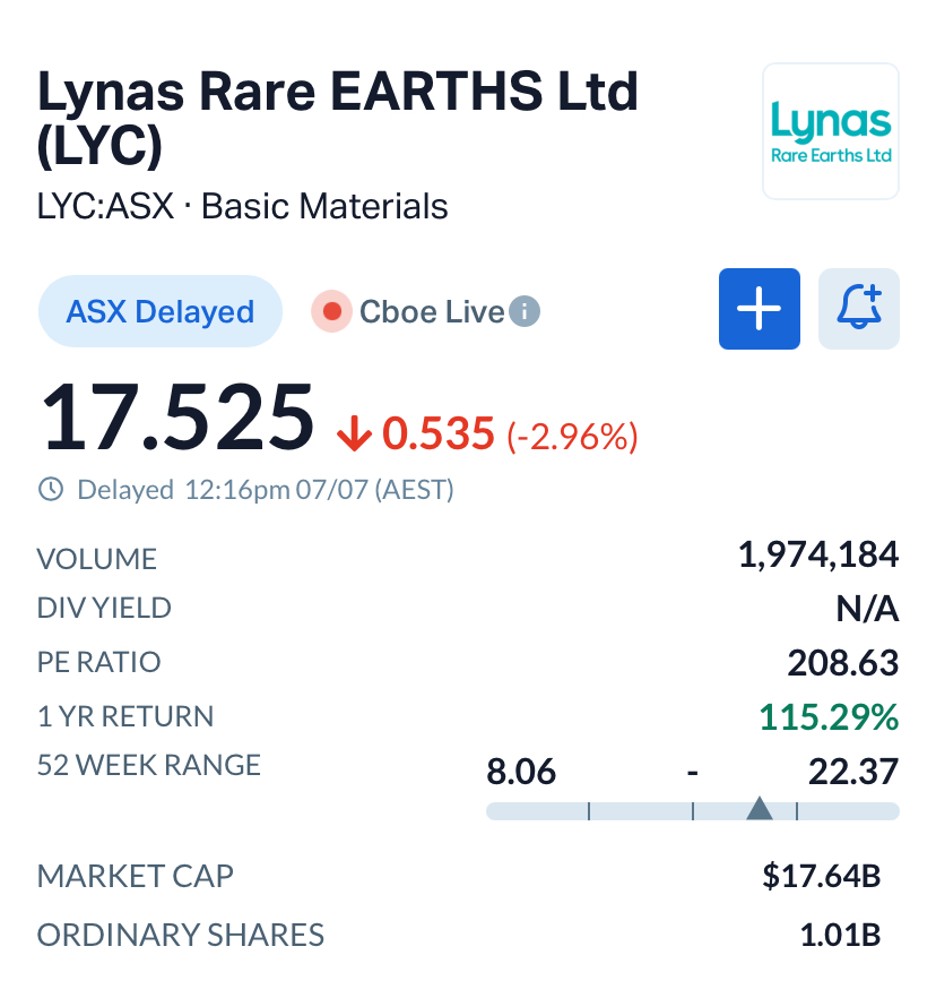
Lynas Shares were trading at A$17.525, down 2.96% by late morning despite the positive strategic news.
Source: MarketIndex
The pullback may reflect several factors. Lynas has already delivered a 115.29% return over the past year, leaving some investors to lock in profits after a strong rally. Others may have been hoping for a more immediate earnings catalyst such as higher production guidance, additional customer contracts or stronger rare earth pricing. While the partnership expands Lynas’ strategic positioning, the factory still needs to be built before meaningful financial contributions emerge.
Even so, the announcement reinforces an increasingly important trend across the critical minerals sector. Investors are placing greater value on companies that control more of the supply chain rather than simply producing raw materials. By adding permanent magnet manufacturing to its processing expertise, Lynas is positioning itself closer to end users across electric vehicles, renewable energy, advanced manufacturing and defence, industries expected to drive rare earth demand for years to come.
Source: Lynas ASX Announcement (7 July 2026); International Energy Agency Critical Minerals Market Review; European Critical Raw Materials Act.
What is your take on this story?
This is user sentiment & not financial advice.
Disclaimer - Skrill Network is designed solely for educational and informational use. The content on this website should not be considered as investment advice or a directive. Before making any investment choices, it is crucial to carry out your own research, taking into account your individual investment objectives and personal situation. If you're considering investment decisions influenced by the information on this website, you should either seek independent financial counsel from a qualified expert or independently verify and research the information.