


ASX Market Wrap: ASX 200 Slips as RBA Looms, Despite Wall Street’s Record-Breaking Rally

Team Skrill Network
Team Skrill Network comprises seasoned professionals from diverse fields including Finance, Mining, Technology, Investing, and Digital Strategy. They bring a deep knowledge and understanding of financial markets and behavioural patterns to every story, ensuring credibility and precision in every piece. Whether analysing emerging market trends or spotlighting small- and mid-cap growth companies across ASX, TSX, or NASDAQ, the team’s editorial approach blends data-driven insights with compelling storytelling. Their expertise enables them to process complex developments into content that resonates with both institutional investors and retail audiences. Backed by experience in content curation, SEO strategy, and investor-focused messaging, the team of writers at Skrill Network are committed to delivering stories that matter—authentic, relevant, and strategically aligned with the evolving landscape of global investing.
Read more
Key Highlights
• ASX 200 falls 0.43% as investors lock in gains ahead of the RBA decision
• Wall Street hits fresh record highs after a US-Iran ceasefire framework eases global tensions
• Ten of eleven ASX sectors trade lower, with technology and industrials leading declines
• Southern Cross Electrical Engineering (ASX:SXE) jumps 14.43% after a heavily backed $150 million capital raise
• Analysts say caution rather than panic is driving today’s market pullback
The Australian share market spent Tuesday looking inward.
While Wall Street celebrated record highs and a geopolitical breakthrough between the United States and Iran, local investors chose caution over optimism, sending the S&P/ASX 200 lower ahead of a crucial Reserve Bank of Australia interest rate decision.
Market Snapshot
By late morning, the benchmark ASX 200 had slipped 38.5 points, or 0.43%, to 8,875.5, while the All Ordinaries fell by a similar margin to 9,089.1.
The weakness stood in stark contrast to offshore markets.
Overnight, the S&P 500 surged 1.65%, the Nasdaq jumped 3.07%, and the Dow Jones climbed 0.92%, all buoyed by news that Washington and Tehran had reached a Memorandum of Understanding aimed at ending recent hostilities in the Middle East.
The agreement triggered a sharp unwinding of risk premiums across commodity markets, with oil prices tumbling more than 4% overnight as fears surrounding the Strait of Hormuz eased.
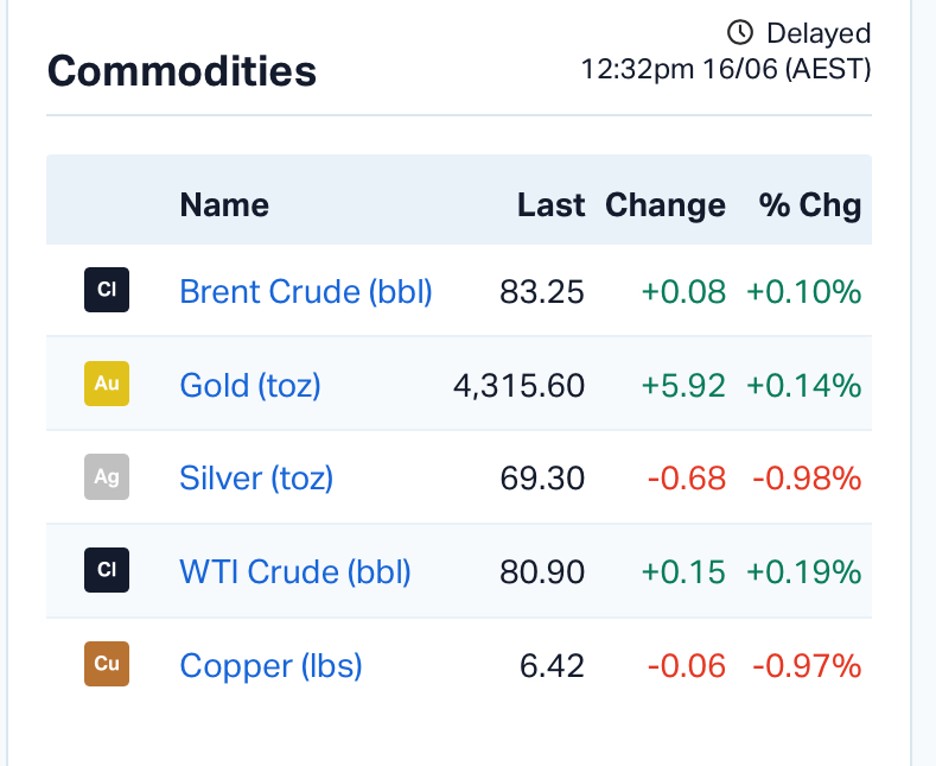
Commodities Price Index | Source: MarketIndex
Yet Australian investors appeared more focused on what was about to happen at home.
The RBA was scheduled to announce its latest interest rate decision later in the day, with markets assigning a near-certain probability that the cash rate would remain unchanged at 4.35%.
Still, after three rate hikes earlier in 2026, traders appeared reluctant to take on fresh risk.
“There’s a bit of nervousness ahead of this afternoon’s RBA Board meeting,” IG market analyst Tony Sycamore said.
“The ASX index has rallied around 300 points, or 3.5%, from Friday’s low to yesterday’s high. That’s a good rally in a short space of time, so some selling to lock in gains this morning isn’t surprising.”
The pullback was broad-based.
Ten of the market’s eleven sectors traded in negative territory, with Information Technology falling 1.85% and Industrials dropping 1.53%.
Energy was the lone bright spot, rising 1.31% despite softer crude prices.
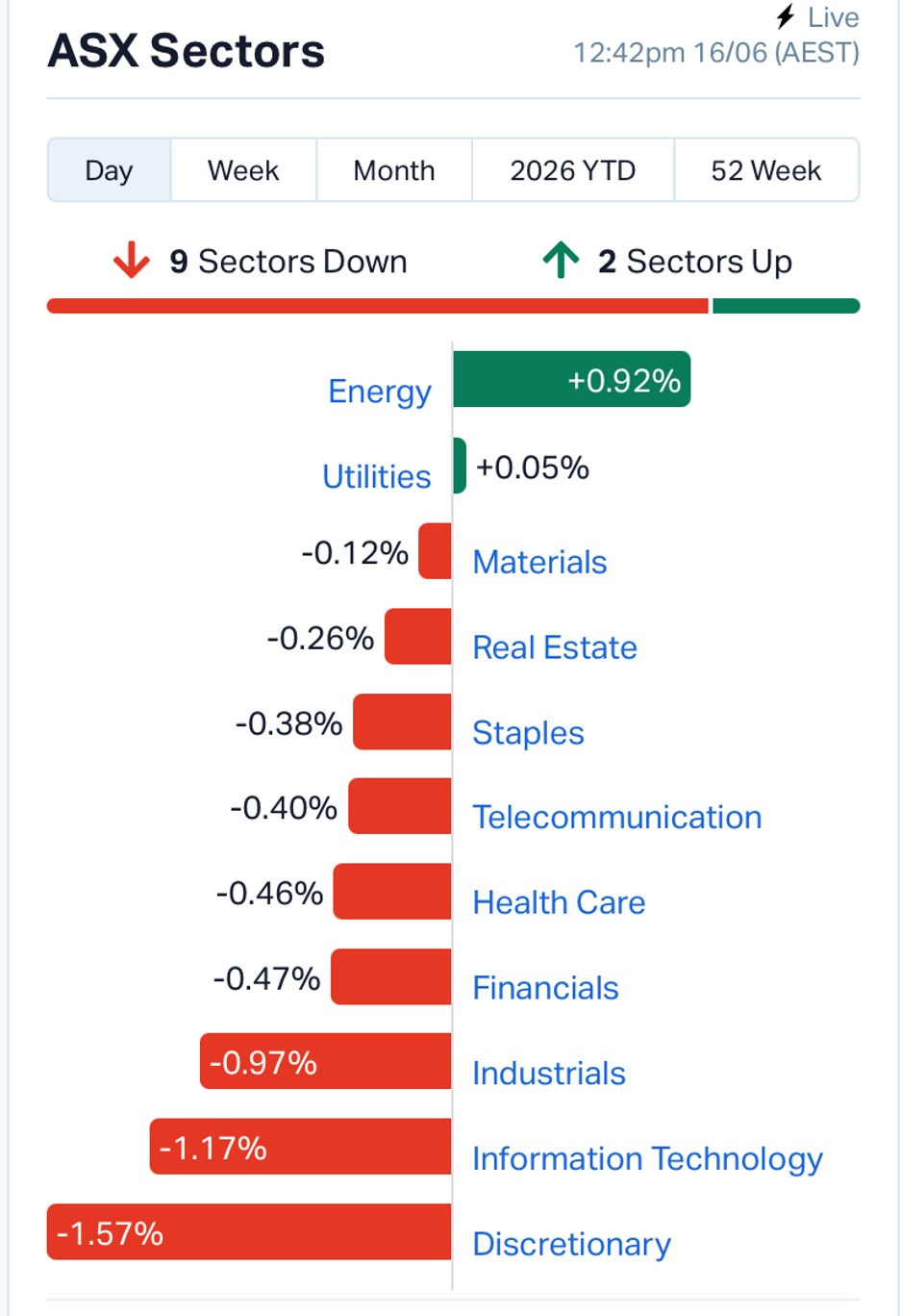
ASX Sector Snapshot | Source: MarketIndex
The local market’s caution comes as central banks across the world move in different directions.
While the RBA is expected to pause, the Bank of Japan is widely tipped to raise rates again as it continues its historic exit from ultra-loose monetary policy. That shift has helped propel Japan’s Nikkei 225 to fresh all-time highs.
Economists remain divided on how much further Australian rates may need to rise.
AMP Deputy Chief Economist Diana Mousina said inflation remains a concern despite signs of economic slowing.
“Three consecutive rate rises is quite a fast tightening pace,” Mousina said.
“The RBA does not need to rush and raise rates again. However, it’s definitely not comfortable with where inflation is at at the moment.”
Away from macroeconomics, several corporate stories shaped trading.
Southern Cross Electrical Engineering (ASX:SXE) emerged as one of the day’s standout performers, surging 14.43% to $4.60 after successfully completing a $150 million institutional placement.
The raise cleared at the top of its bookbuild range and highlighted strong institutional appetite for companies exposed to data centres, renewable energy infrastructure and Australia’s broader electrification trend.
The rally pushed SXE’s market capitalisation beyond $1.2 billion and reinforced growing investor interest in infrastructure businesses linked to artificial intelligence and energy transition themes.
Dateline Resources (ASX:DTR) rose 17.31% to $0.152, while Alpha HPA (ASX:A4N) gained 11.18% as investors rotated back into select resource and advanced materials stocks.
Stay ahead of the market
The most important stories, delivered to your inbox. No noise, just what matters.
By subscribing, you agree to our Privacy Policy.
Not all companies shared in the optimism.
Titanium materials developer IperionX (ASX:IPX) tumbled 16.73% to $4.53 amid profit-taking after a strong run, while Karoon Energy (ASX:KAR) fell 6.99% as weaker oil prices weighed on sentiment.
Bougainville Copper (ASX:BOC) shed more than 10% following ongoing regulatory uncertainties.
Globally, investors are now trying to determine whether the easing of Middle East tensions will have a lasting impact on inflation.
Capital.com analyst Daniela Hathorn said lower oil prices could give policymakers more flexibility.
“The sharp decline in oil prices does not eliminate inflation risks altogether, but it does reduce some of the urgency surrounding them,” she said.
“Attention is now shifting back toward monetary policy.”
Despite the ceasefire agreement, analysts remain cautious about assuming a rapid return to normal conditions in global energy markets.
Sycamore noted that restoring shipping confidence, clearing maritime routes and rebuilding insurance coverage could take time, even if hostilities continue to ease.
That measured approach appeared to define Tuesday’s trading session.
Wall Street may be celebrating record highs, but Australian investors are still focused on the next chapter of monetary policy.
For now, the market seems content to wait for the RBA’s verdict before deciding whether the recent rally has further room to run.
What is your take on this story?
This is user sentiment & not financial advice.
Disclaimer - Skrill Network is designed solely for educational and informational use. The content on this website should not be considered as investment advice or a directive. Before making any investment choices, it is crucial to carry out your own research, taking into account your individual investment objectives and personal situation. If you're considering investment decisions influenced by the information on this website, you should either seek independent financial counsel from a qualified expert or independently verify and research the information.