


ASX Market Wrap: Softer Inflation Calms Rate Fears as Banks Sink the Local Market

Team Skrill Network
Team Skrill Network comprises seasoned professionals from diverse fields including Finance, Mining, Technology, Investing, and Digital Strategy. They bring a deep knowledge and understanding of financial markets and behavioural patterns to every story, ensuring credibility and precision in every piece. Whether analysing emerging market trends or spotlighting small- and mid-cap growth companies across ASX, TSX, or NASDAQ, the team’s editorial approach blends data-driven insights with compelling storytelling. Their expertise enables them to process complex developments into content that resonates with both institutional investors and retail audiences. Backed by experience in content curation, SEO strategy, and investor-focused messaging, the team of writers at Skrill Network are committed to delivering stories that matter—authentic, relevant, and strategically aligned with the evolving landscape of global investing.
Read more
Key Highlights
- ASX 200 trades flat despite softer-than-expected inflation data
- April CPI slows to 4.2%, sharply reducing June rate hike expectations
- Big Four banks tumble, dragging down the broader financial sector
- Technology stocks rally alongside Wall Street’s AI-driven surge
- Brent crude remains elevated near US$99 amid Middle East tensions
The Australian share market spent Wednesday caught between two competing forces.
Cooling inflation figures eased fears of another near-term interest rate rise, but a heavy sell-off across the banking sector kept the broader market pinned near flat territory.
By midday, the S&P/ASX 200 was barely moving, up 0.03% to 8,660.5 points, while the All Ordinaries edged 0.10% higher. Technology shares continued to outperform, with the ASX All Technology Index climbing 1.28%.
Market Snapshot
The mood across global markets remained sharply divided.
Overnight, Wall Street’s technology-heavy Nasdaq surged 1.19% to another record high as artificial intelligence enthusiasm continued driving global tech stocks higher. The S&P 500 also gained 0.61%, while the Dow Jones slipped 0.23%.
The AI rally spilled into Asia earlier in the session, with South Korea’s KOSPI and Japanese technology-linked names continuing to attract strong momentum.
Australia, however, remains structurally different.
Unlike US markets dominated by mega-cap technology groups, the ASX still leans heavily on banks, miners and dividend-paying industrials. That composition has increasingly left the local market lagging behind the global AI-driven rally.
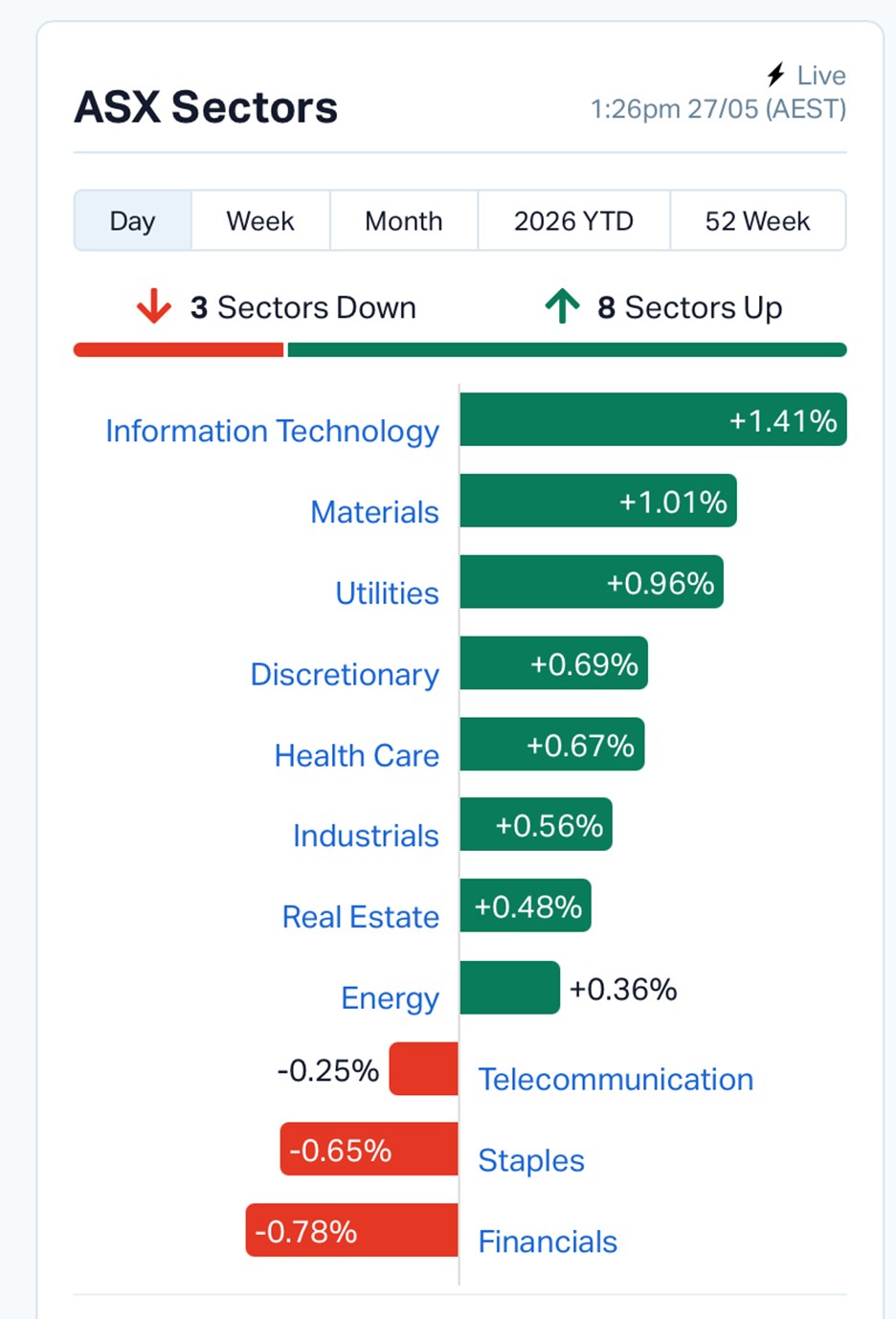
ASX Sector Snapshot | Source: MarketIndex
Inflation finally cools, but not evenly
The major domestic talking point came from the latest inflation figures released by the Australian Bureau of Statistics.
Headline annual inflation slowed to 4.2% in April from 4.6% in March, coming in below economist expectations of 4.4%.
The softer number immediately shifted interest rate expectations.
Financial markets rapidly pared back the implied probability of a June Reserve Bank rate rise from 14% to just 7.5%, according to LSEG data.
Fuel prices played a major role in the cooling print.
Automotive fuel prices fell 7% during April after surging 32.8% the month before, helped by the federal government’s temporary fuel excise cut.
Treasurer Jim Chalmers pointed directly to that policy intervention.
“The results show that the government’s decisive action to slash the fuel excise is helping to take some of the sting out of price pressures from the conflict,” Dr Chalmers said.
“Treasury analysis shows that our cut to the fuel excise reduced headline inflation by around 0.5 of a percentage point.”
Yet beneath the headline figure, underlying inflation remained more stubborn.
The Reserve Bank’s preferred trimmed mean inflation measure edged slightly higher to 3.4% from 3.3%, still sitting above the RBA’s 2% to 3% target range.
Anders Magnusson, chief economist at BDO, said the data still carried warning signs beneath the surface.
“Headline inflation was always going to moderate a little, but remain elevated in April while energy prices stayed high,” he said.
“The more important signal is that trimmed mean inflation has just started to rise.”
Banks become the market’s biggest drag
While inflation relief supported sentiment in pockets of the market, the financial sector became the clear weak point.
The ASX 200 Banks Index slumped 1.61%, with all four major lenders trading lower.
Westpac came under additional pressure after the Federal Court imposed a $26 million fine tied to delays in responding to customers facing financial hardship.
ASIC Deputy Chair Sarah Court delivered a blunt assessment of the failures.
“Westpac failed the very customers who needed help when they needed it most,” she said.
“These were customers who were asking for some breathing room for a range of reasons, including domestic abuse, natural disasters, serious illness or the loss of their job.”
The weakness across financials largely offset gains elsewhere in the market, particularly in technology and resources.
AI momentum lifts local tech names
The technology sector continued benefiting from global AI enthusiasm.
Megaport Ltd jumped 7.54% to $14.83 as investors chased companies tied to cloud infrastructure and data demand.
Stay ahead of the market
The most important stories, delivered to your inbox. No noise, just what matters.
By subscribing, you agree to our Privacy Policy.
The broader AI buildout, however, is beginning to raise new questions around energy consumption.
A report commissioned by Greenpeace warned that Australia’s rapidly expanding AI data centre sector could outpace the country’s broader electrification efforts, potentially delaying the transition away from coal and gas generation.
That tension between technological expansion and energy infrastructure is increasingly becoming a global market theme.
Oil markets remain tense
Energy markets also remained in focus as geopolitical tensions lingered in the Middle East.
Brent crude traded near US$98.74 a barrel, while WTI crude hovered above US$92.
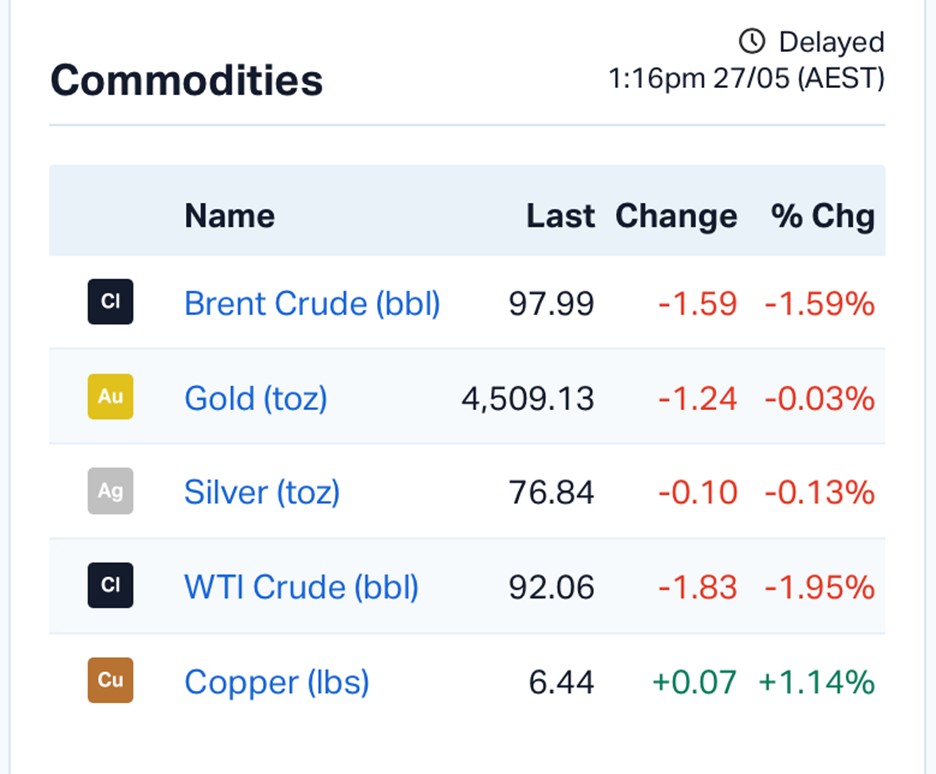
Commodities Snapshot | Source: MarketIndex
Iran accused the United States of violating a fragile ceasefire agreement earlier in the week, reviving concerns around shipping routes through the Strait of Hormuz, a critical corridor for global oil and LNG flows.
Oxford Economics Australia economist Harry McAuley said the inflation outlook still depends heavily on how long regional tensions persist.
“We are seeing the first glimpses of the wider inflationary impacts of high oil prices bleeding through the wider economy,” he said.
“Our outlook is contingent on a reopening of the Strait of Hormuz next month. The longer the conflict drags on, the higher the risk that inflation exceeds our expectations.”
Still, volatility indicators remained subdued.
The ASX VIX index sat near 12.2, suggesting traders still expect relatively stable conditions over the next month despite the geopolitical backdrop.
What is your take on this story?
This is user sentiment & not financial advice.
Disclaimer - Skrill Network is designed solely for educational and informational use. The content on this website should not be considered as investment advice or a directive. Before making any investment choices, it is crucial to carry out your own research, taking into account your individual investment objectives and personal situation. If you're considering investment decisions influenced by the information on this website, you should either seek independent financial counsel from a qualified expert or independently verify and research the information.