


Nufarm’s (ASX: NUF) Strategic Pivot Sparks Major Earnings Growth

Team Skrill Network
Team Skrill Network comprises seasoned professionals from diverse fields including Finance, Mining, Technology, Investing, and Digital Strategy. They bring a deep knowledge and understanding of financial markets and behavioural patterns to every story, ensuring credibility and precision in every piece. Whether analysing emerging market trends or spotlighting small- and mid-cap growth companies across ASX, TSX, or NASDAQ, the team’s editorial approach blends data-driven insights with compelling storytelling. Their expertise enables them to process complex developments into content that resonates with both institutional investors and retail audiences. Backed by experience in content curation, SEO strategy, and investor-focused messaging, the team of writers at Skrill Network are committed to delivering stories that matter—authentic, relevant, and strategically aligned with the evolving landscape of global investing.
Read more
Key Highlights
- Nufarm posts 28% rise in statutory NPAT to $38 million for HY26
- Underlying EBITDA climbs 18% to $243 million despite lower revenue
- Gross profit margin expands sharply to 33.1%
- Seed Technologies EBITDA jumps 113% on bp biofuel partnership momentum
- Net debt reduced by $135 million as leverage target remains in focus
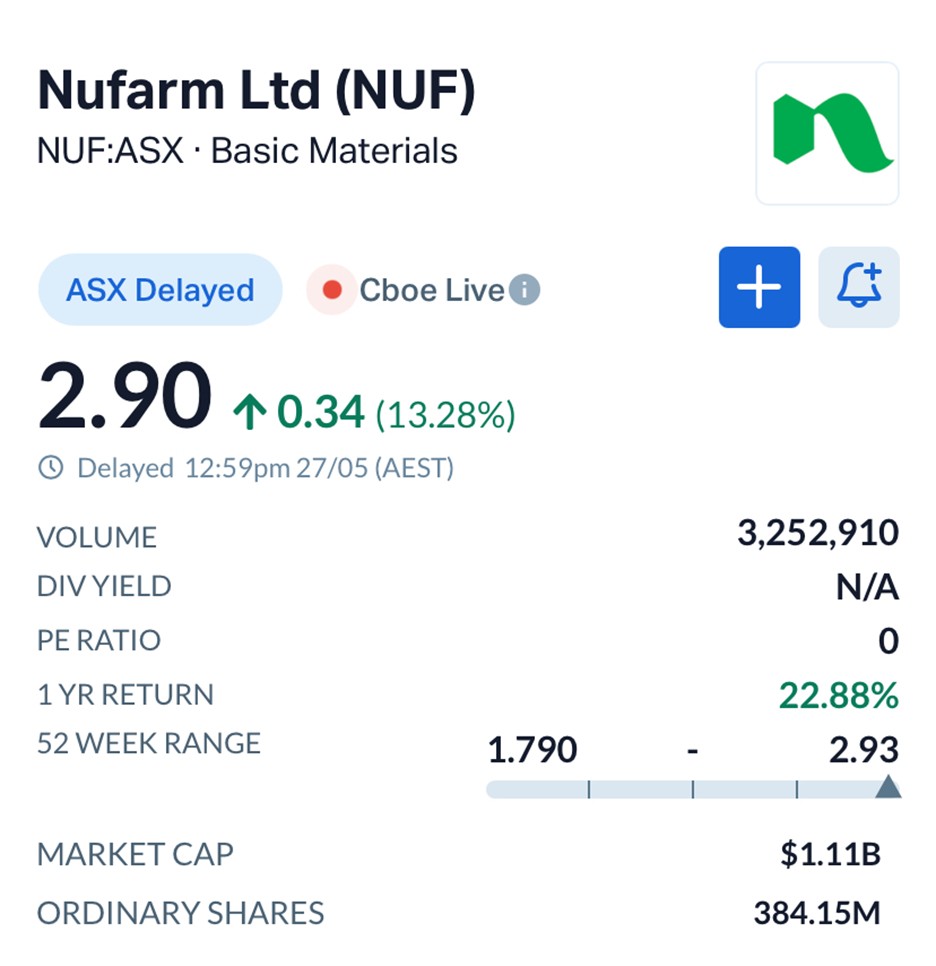
Nufarm Ltd climbed more than 13% in Wednesday trade after the agricultural chemicals and seed technologies group reported a sharp lift in earnings, even as overall sales eased during the half.
The result reflected a company leaning harder into margin discipline and higher-value growth areas rather than chasing raw sales volume.
Nufarm posted statutory net profit after tax of $38 million for the first half of FY26, up 28% from a year earlier. Underlying NPAT rose 35% to $52 million, while underlying EBITDA increased 18% to $243 million.
Market Snapshot
Revenue slipped 5.3% to $1.714 billion.
The contrast between lower revenue and stronger earnings became the central theme of the result.
Underlying gross profit margins improved to 33.1%, up from 29.4% a year ago, as the company continued exiting lower-margin products while tightening operating costs across key regions.
The market appeared to reward the shift.
Nufarm shares traded at $2.90 by midday on Wednesday, their highest level in the past 12 months.
Source: MarketIndex
Europe becomes the surprise earnings engine
Europe, long viewed as one of the company’s tougher operating regions due to regulatory pressures and elevated compliance costs, emerged as one of the strongest contributors during the half.
Underlying EBITDA from the European business rose 19% to $113 million.
Management credited structural cost reductions, tighter portfolio management and a stronger mix of higher-value products.
The improvement follows Nufarm’s broader restructuring program announced earlier this year, targeting approximately $50 million in annualised savings by late FY27.
Across the wider business, net debt fell by $135 million from the prior corresponding period to $1.23 billion, while leverage improved 20% to 3.6 times underlying EBITDA.
The company maintained its target of reducing leverage to 2.0 times by the end of FY26.
That focus on debt reduction came with a trade-off.
Nufarm declared no interim dividend, with the board reiterating that capital returns remain tied to achieving its leverage range of 1.5x to 2.0x.
Seeds division emerges as a major growth platform
While traditional crop protection operations remained mixed across regions, the company’s Seed Technologies division delivered the standout performance of the half.
Underlying EBITDA surged 113% to $58 million.
Much of that momentum came from Nufarm’s expanding bioenergy partnership with bp plc, centred on the company’s proprietary carinata seed platform.
The partnership, recently extended through to 2050, focuses on scaling production systems for sustainable aviation fuel and renewable diesel feedstocks.
The result reflects a broader transition underway inside the company.
Historically known for generic crop protection chemicals, Nufarm has increasingly repositioned itself toward higher-margin agricultural technology and bio-based products.
The company’s omega-3 platform also moved closer to commercial scale during the half.
Nufarm began regulated planting trials in Argentina while also securing final consumption deregulation approval in Japan.
Losses from the omega-3 segment narrowed sharply to $4 million from $30 million a year earlier.
Weather and geopolitics continue to pressure agriculture
The broader operating backdrop remained uneven.
Nufarm said dry weather conditions in Australia weighed heavily on Asia-Pacific earnings, with regional EBITDA falling 15% to $55.5 million.
Stay ahead of the market
The most important stories, delivered to your inbox. No noise, just what matters.
By subscribing, you agree to our Privacy Policy.
North America delivered steadier growth, helped by stronger demand in turf and ornamental products and resilient Canadian conditions.
Globally, agricultural markets continue navigating elevated freight costs, volatile energy pricing and supply chain disruptions linked to ongoing Middle East tensions.
Those pressures are also beginning to reshape planting decisions.
Rabobank recently warned that higher diesel and fertiliser costs were expected to reduce Australia’s winter cropping area during the 2026/27 season.
Against that backdrop, Nufarm’s emphasis on higher-margin technologies and structural cost discipline is increasingly being viewed as defensive positioning rather than short-term optimisation.
A different kind of agriculture company emerging
For much of the past decade, agricultural chemical businesses were often judged by scale and sales growth.
Nufarm’s latest result suggested a different playbook may now be taking hold.
The company generated stronger profits while deliberately shrinking parts of its lower-return portfolio.
At the same time, its higher-growth seed technologies business is beginning to contribute a larger share of earnings.
Management also upgraded expected FY26 EBITDA improvement from Emerging Platforms to $40 million, up from previous guidance of $30 million.
The combination of margin expansion, lower leverage and improving biotech seed economics is gradually reshaping how the market values the company.
What once looked like a cyclical chemicals business is increasingly leaning toward a more specialised agtech profile.
What is your take on this story?
This is user sentiment & not financial advice.
Disclaimer - Skrill Network is designed solely for educational and informational use. The content on this website should not be considered as investment advice or a directive. Before making any investment choices, it is crucial to carry out your own research, taking into account your individual investment objectives and personal situation. If you're considering investment decisions influenced by the information on this website, you should either seek independent financial counsel from a qualified expert or independently verify and research the information.