


Why Recce’s (ASX: RCE) Middle East Deal Could Mark a Turning Point for ASX Biotech Funding

Team Skrill Network
Team Skrill Network comprises seasoned professionals from diverse fields including Finance, Mining, Technology, Investing, and Digital Strategy. They bring a deep knowledge and understanding of financial markets and behavioural patterns to every story, ensuring credibility and precision in every piece. Whether analysing emerging market trends or spotlighting small- and mid-cap growth companies across ASX, TSX, or NASDAQ, the team’s editorial approach blends data-driven insights with compelling storytelling. Their expertise enables them to process complex developments into content that resonates with both institutional investors and retail audiences. Backed by experience in content curation, SEO strategy, and investor-focused messaging, the team of writers at Skrill Network are committed to delivering stories that matter—authentic, relevant, and strategically aligned with the evolving landscape of global investing.
Read more
Key Highlights
- Recce signs non-binding 10-year licensing term sheet across more than 30 Middle Eastern markets
- Deal includes up to US$3.5 million in upfront and milestone payments
- Recce to receive 30% of net selling price for R327G treatments
- Saudi Arabia among the world’s highest diabetes prevalence markets
- Indonesian Phase 3 trial data expected to support regional approvals
Australia’s biotech sector has long wrestled with a familiar cycle. Promising drug developers often spend years raising fresh capital to fund clinical trials, only to dilute shareholders before commercial revenue ever arrives.
This week, Recce Pharmaceuticals Ltd offered a different blueprint.
The company unveiled a non-binding term sheet tied to a proposed exclusive 10-year licensing and distribution agreement with a large Middle Eastern pharmaceutical group covering more than 30 international markets.
Market Snapshot
The agreement centres on RECCE® 327 Topical Gel, known as R327G, a synthetic anti-infective treatment targeting diabetic foot infections.
The commercial terms immediately stood out.
Recce said the proposed arrangement includes upfront and milestone payments of up to US$3.5 million, alongside a 30% share of the net selling price and an additional 6% annual royalty on sales above US$50 million per year.
The proposed treatment price is set at US$1,500 per course, subject to regulatory approval in Saudi Arabia.
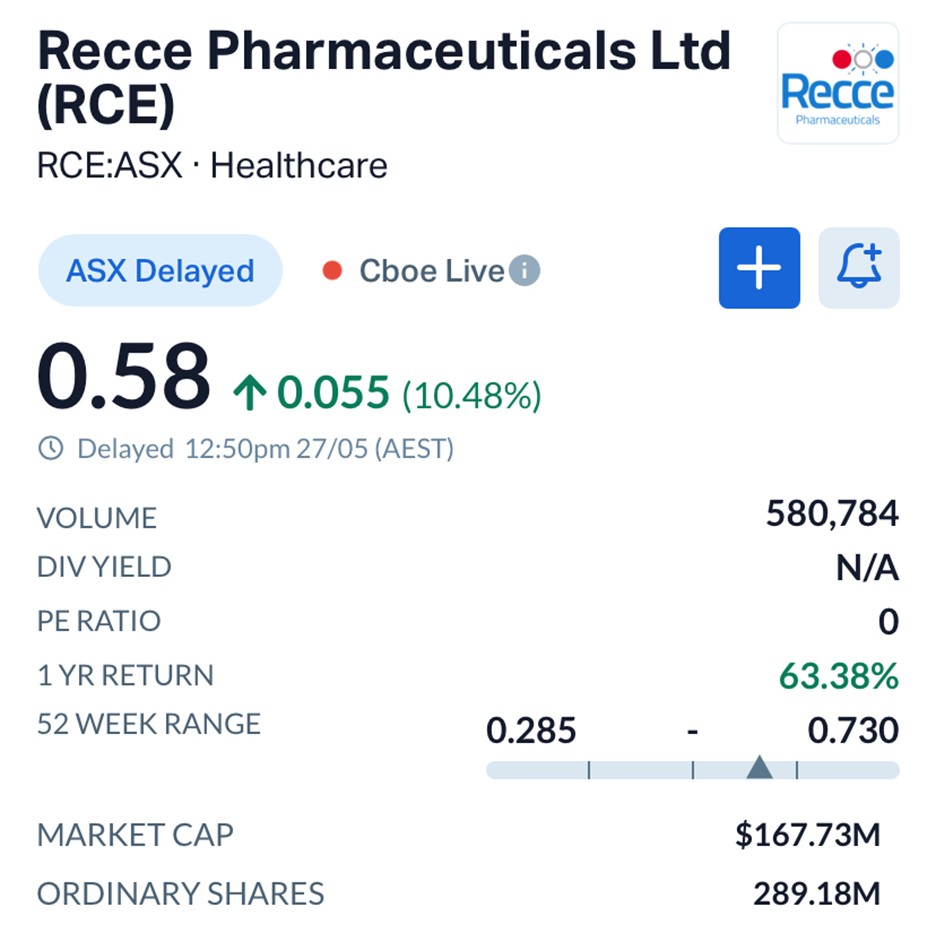
Shares in Recce climbed 10.48% to 58 cents by late morning trade on Wednesday, extending the stock’s one-year gain to more than 63%.
Source: MarketIndex
A region confronting a diabetes crisis
The broader story sits well beyond a standard biotech licensing deal.
The Middle East and North Africa region has become one of the world’s largest diabetes hotspots, with more than 84 million people living with the condition across the region.
Saudi Arabia alone carries a diabetes prevalence rate of 23.1% among adults, according to regional health data, placing the Kingdom among the highest globally.
That burden creates a secondary healthcare challenge often overlooked outside medical circles.
For many diabetic patients, minor wounds can rapidly deteriorate into severe foot infections due to reduced circulation and nerve damage. In extreme cases, infections progress toward tissue death and amputation.
At the same time, antimicrobial resistance continues weakening the effectiveness of traditional antibiotics worldwide.
Recce’s R327G treatment has been positioned as a potential alternative approach because its synthetic polymer technology physically disrupts bacterial cell walls rather than targeting bacteria through conventional antibiotic pathways.
The company argues this mechanism reduces the likelihood of bacterial resistance developing over time.
Clinical shortcuts lower the cost burden
One of the more commercially significant details in the announcement was regulatory.
Recce plans to use data from its ongoing 310-patient Phase 3 registrational trial in Indonesia to support marketing applications across Saudi Arabia and surrounding Middle Eastern territories.
No additional regional clinical trials are currently expected.
Running multiple country-specific trials can consume tens of millions of dollars and delay commercialisation by several years.
Instead, the proposed Middle Eastern rollout effectively piggybacks on an existing advanced-stage clinical program already underway in Indonesia.
The definitive agreement is expected to be completed in the third quarter of 2026.
A different biotech funding model emerges
The structure of the agreement also shifts much of the commercial execution burden away from Recce itself.
Under the proposed arrangement, the Middle Eastern pharmaceutical partner would manage local registration, distribution, hospital access and marketing operations across the region.
Recce’s role would largely focus on manufacturing and supply.
That creates a markedly different profile from the traditional ASX biotech pathway, where smaller companies often attempt to build expensive commercial infrastructure internally.
Stay ahead of the market
The most important stories, delivered to your inbox. No noise, just what matters.
By subscribing, you agree to our Privacy Policy.
Instead, Recce gains access to established regional pharmaceutical networks without carrying the full operating cost base itself.
CEO James Graham framed the agreement as validation of the company’s broader anti-infective platform.
“This is a major milestone in the development and commercialisation of Recce’s anti-infective platform,” he said.
“The proposed establishment of marketing and distribution channels for R327G across the MENA region highlights the growing demand for novel, innovative, and groundbreaking treatments for addressing antimicrobial resistance.”
He added that the agreement marked “a positive step in the commercialisation pathway of Recce’s innovative pipeline as a next-generation solution for addressing the infectious disease challenges associated with the global pandemic of diabetes.”
Biotech markets shifting toward commercial discipline
The timing also reflects a broader shift across global biotech markets.
After several years of rising interest rates and tighter capital conditions, investors have increasingly favoured companies capable of demonstrating clearer commercial pathways rather than purely research-stage narratives.
Licensing deals with upfront cash payments, milestone structures and regional revenue-sharing agreements have become more important markers of valuation support.
Recce’s agreement arrives while healthcare systems globally continue searching for new anti-infective solutions amid growing antimicrobial resistance concerns.
The company has previously received Qualified Infectious Disease Product designation from the US FDA under the GAIN Act, providing additional regulatory recognition for its technology platform.
For now, the Middle Eastern agreement remains non-binding.
But for a sector often criticised for prolonged cash burn and endless capital raisings, the structure itself may prove just as important as the drug at the centre of it.
What is your take on this story?
This is user sentiment & not financial advice.
Disclaimer - Skrill Network is designed solely for educational and informational use. The content on this website should not be considered as investment advice or a directive. Before making any investment choices, it is crucial to carry out your own research, taking into account your individual investment objectives and personal situation. If you're considering investment decisions influenced by the information on this website, you should either seek independent financial counsel from a qualified expert or independently verify and research the information.